Your furnace kicked on for the first time this fall with a burnt dust smell and a rattle you don't remember from last year. You check the sticker, and it went in 17 years ago. Sooner or later you'll replace it, and the choice in front of you isn't only which furnace to buy. For a lot of homes it's whether to replace your gas furnace with a heat pump instead.
About half of Massachusetts homes heat with natural gas. The federal government's 2020 Residential Energy Consumption Survey put it at 53 percent, and in the city of Worcester gas is the main heating fuel for roughly half of households. Here is how to answer that question honestly for your house.
The Short Answer
If your furnace is near the end of its life and your ductwork can carry the airflow a heat pump needs, a heat pump is worth a serious look in 2026, even if it costs somewhat more to run. For most households, the rebate money sits entirely on the heat pump side now. A heat pump also replaces your central air conditioner, so if that's aging too, one install covers both. A new gas furnace still makes sense in some homes, covered below.
What Changed: No More Rebates for Gas Furnaces
Mass Save used to pay rebates on high efficiency gas furnaces. It doesn't anymore. Following the state's 2021 climate law, Mass Save discontinued rebates, incentives, and financing for natural gas, oil, and propane equipment. Residential equipment had to be purchased and installed by August 31, 2024. The only exception is for income eligible households.
Heat pumps, meanwhile, still carry real money in 2026. For an air source heat pump, Mass Save pays:
Whole home: up to $2,650 per ton, capped at $8,500, when the heat pump becomes your only heating source.
Partial home: up to $1,125 per ton, capped at $8,500, when you keep the existing furnace in place.
Both figures are verified as of October 2026, and the install has to happen between January 1 and December 31, 2026, with paperwork filed by February 28, 2027. For a 3 ton system, that works out to up to $7,950 for whole home or up to $3,375 for partial home.
If gas heats your home, eligibility runs through your Mass Save gas sponsor: Berkshire Gas, Eversource, Liberty, National Grid, or Unitil.
Whole Home or Keep the Furnace as Backup?
Whole home
The heat pump does all the heating, and the furnace comes out. Mass Save requires the home to meet its weatherization standard and to be occupied full time through the winter. The weatherization standard can be met if the home was built in 2000 or later, if an energy assessment finds less than $1,000 of recommended work, or if that work has already been done.
Partial home, also called dual fuel
You keep the gas furnace as backup and add a heat pump that carries most of the load. The rebate is lower per ton. There's also a firm condition. Mass Save requires an integrated control from its qualified product list for every heating zone where gas stays in use, and without it those zones don't qualify. The control decides when the heat pump runs and when the furnace takes over.
Partial home suits a furnace that's only a few years old, or a homeowner who wants a fallback for the coldest nights. Whole home suits a furnace that's due for replacement anyway, since you're not keeping equipment you'd otherwise retire.
Can Your Existing Ductwork Handle a Heat Pump?
Furnace homes start with an advantage: the ducts already exist. Whether they're the right size is the question.
Mass Save's guide for new owners notes that furnaces often push out air at 120 to 160 degrees, while heat pump supply air typically runs about 85 to 105 degrees. To deliver the same heat at a lower temperature, a heat pump moves more air. A Consortium for Energy Efficiency guide hosted by the Department of Energy puts the usual minimum at 350 to 400 cubic feet per minute per ton. It also warns that ducts too small for that airflow can cause inefficiency, poor comfort, or noise.
An installer should measure your ducts and run a load calculation before recommending a size. The ducts may work as they are, or they may need an added return, a larger trunk, or a few supplemental ductless heads. Get that assessment before you compare prices, because it changes the scope.
Running Costs: The Honest Version
Whether a heat pump costs less to run than a gas furnace depends on your gas and electric rates, how well your house holds heat, and how the system is set up.
For an independent estimate, look at a 2024 study by Harvard's Belfer Center. At April 2024 prices, it found that switching a typical 1,800 square foot gas-heated Massachusetts home to an air source heat pump would add about $400 to $500 a year to the heating bill. Gas homes in towns with unusually low electricity prices were the exception.
That study came out before the seasonal heat pump electric rate began in November 2025. Eversource, National Grid, and Unitil now discount all household electricity from November 1 through April 30 for homes that heat with a heat pump, and all three say partial heat pump homes can qualify.
Gas prices are moving too. National Grid has asked regulators for a base rate increase it estimates at about 8.4 to 9.4 percent on a typical winter gas bill, with a decision due by November 30, 2026.
The fair summary for a gas home is that a heat pump may cost somewhat more to run. The case for switching rests on replacing two systems with one and on the rebates, with the rate discount narrowing the running cost gap.
What a Heat Pump Costs to Install
Installed price depends heavily on the house and its ductwork. EnergySage, which tracks installer quotes on its marketplace, puts the average Massachusetts heat pump quote at $24,482 before incentives as of its March 2026 update. That average mixes ducted and ductless systems of every size, so treat it as a ballpark rather than a price for your home.
Against that, a 3 ton whole home install can earn up to $7,950 from Mass Save, and the instant distributor discount described below can take up to $650 more off per qualifying outdoor unit, verified as of October 2026. The useful comparison is two quotes from the same visit, one for a new furnace and one for a heat pump, both built on your house.
The Other Money on the Table
Rebates aren't the only help:
Mass Save HEAT Loan: zero interest financing up to $25,000 with terms up to 7 years, verified as of October 2026.
New England Heat Pump Accelerator: an instant discount of up to $650 per qualifying outdoor unit, limited to two per home. It appears on the invoice through participating distributors and is designed to stack with Mass Save. The program runs through December 2029.
Sales tax: Massachusetts exempts heat pump systems serving your principal residence from the 6.25 percent sales tax. A gas furnace doesn't get that exemption.
If your gas or electric comes from the town
In Wakefield, the town's Municipal Gas and Light department supplies both, so Mass Save rebates don't apply. Its own 2026 program pays up to $1,000 per ton, capped at $5,000, when a heat pump replaces fossil fuel heat, or up to $1,500 per ton, capped at $7,500, if the gas service is disconnected at the street, verified as of October 2026. Our post on municipal light plant towns covers the other towns in this position.
When a New Gas Furnace Still Makes Sense
We install high efficiency furnaces too, and sometimes that's the right call. A new furnace is often the better fit when:
Your ducts are undersized and fixing them would cost more than the budget allows right now.
You plan to sell within a few years and want the lowest upfront cost.
Your air conditioner is new and you only need heat replaced, and a partial home setup doesn't make sense for the house.
None of those is a permanent no, just a reason the math may not work this year.
Where the Midea EVOX G3 Fits
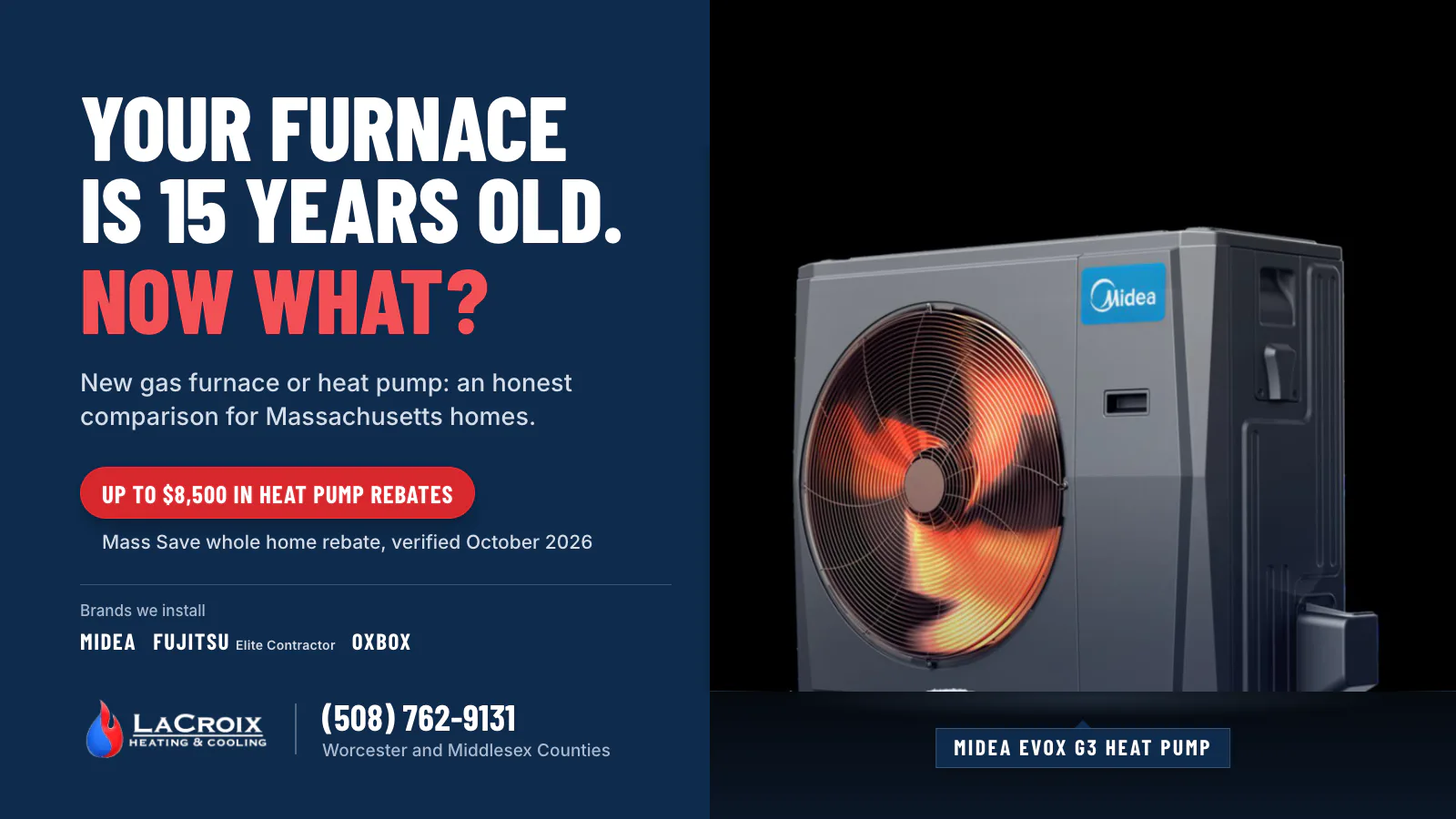
For furnace homes, the Midea EVOX G3 is one of our go-to systems. Midea designed its air handler to replace an existing gas furnace in the same width, and it also supports dual fuel operation with the furnace kept as backup, so it fits either rebate path. Midea rates it for 100 percent heating output at minus 13 degrees.
Making the Call to Replace Your Gas Furnace With a Heat Pump
ENERGY STAR lists a furnace older than 15 years as a sign it's time to start planning a replacement. If yours is there, the worst time to decide is during a January breakdown with one quote on the table. The better path is to decide now whether to replace your gas furnace with a heat pump. Get the ducts measured and both options quoted on the same visit. A 2026 install locks in 2026 rebate rates, and Mass Save rates can change from one year to the next.
Frequently Asked Questions
Can I replace my gas furnace with a heat pump and keep my ductwork?
Often, yes. A heat pump moves more air than a furnace to deliver the same heat, so an installer should measure your ducts and run a load calculation first. Some systems work as they are, and some need a larger return or trunk.
Does Mass Save give a rebate for a new gas furnace?
No. Mass Save discontinued rebates for natural gas, oil, and propane equipment, with a residential cutoff of August 31, 2024. Income eligible households are the only exception.
Can I keep my gas furnace as a backup?
Yes. That's the partial home path, which pays up to $1,125 per ton, capped at $8,500, verified as of October 2026. Mass Save requires an integrated control from its qualified list for each zone where the furnace stays in use.
Is a heat pump cheaper to run than a gas furnace in Massachusetts?
Often not, at least before discounts. A 2024 Belfer Center study estimated that a typical gas-heated home would pay about $400 to $500 more a year with an air source heat pump at April 2024 prices. The seasonal heat pump electric rate, which started in November 2025, narrows that gap, so ask for a comparison built on your own utility bills.
Thinking about what comes after your current furnace? LaCroix Heating and Cooling has installed heat pumps for homeowners across Worcester and Middlesex Counties since 2012. We are a Fujitsu Elite Contractor and a Mass Save approved heat pump installer, and our work carries a 1 year installation warranty plus 12 year manufacturer parts coverage. Call or text (508) 762-9131.