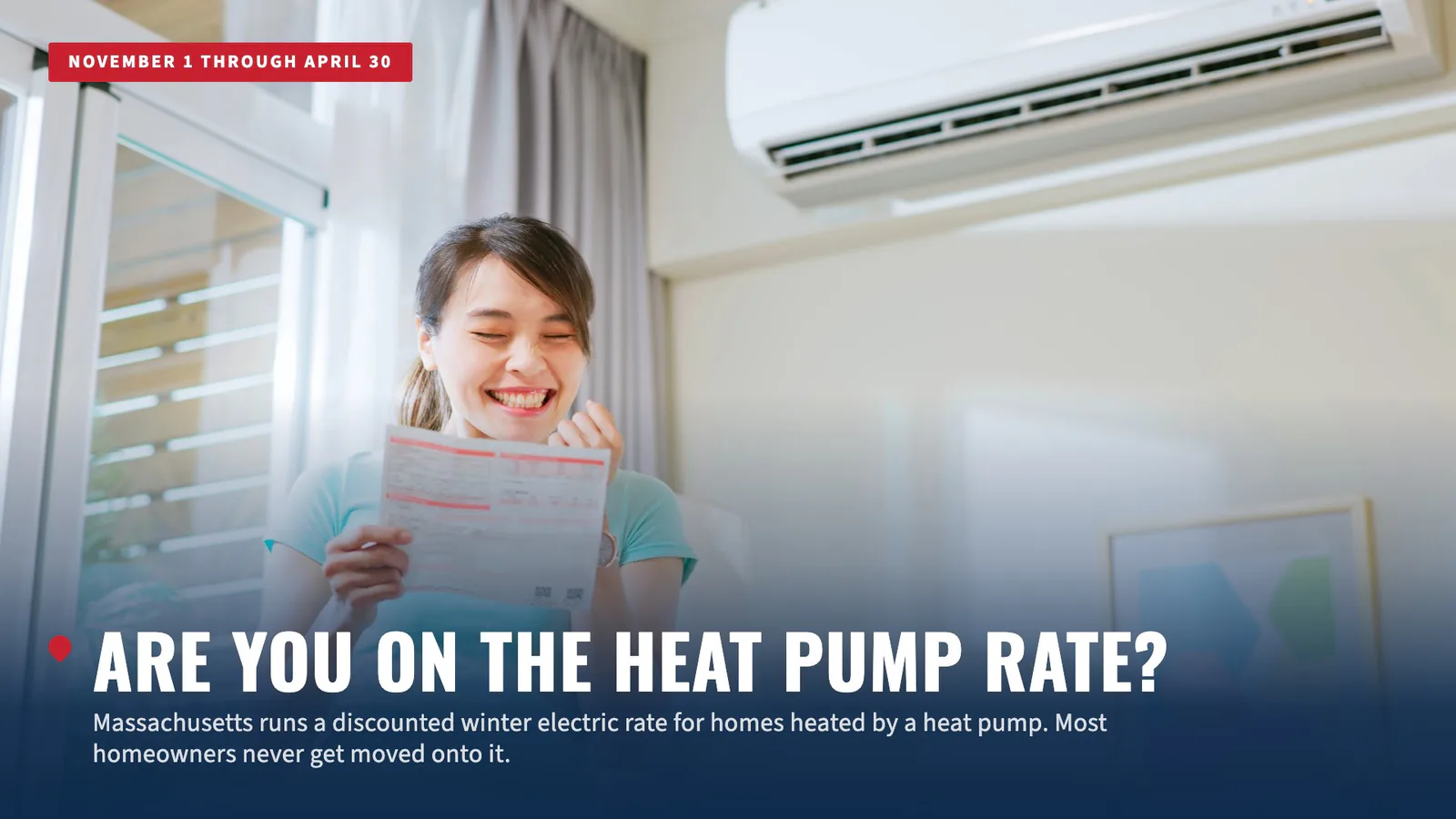
If you heat your home with a heat pump, your electricity is supposed to get cheaper on November 1. Not the supply portion you shop around for, but the delivery charges you have never been able to do anything about. The Massachusetts heat pump electric rate runs through the end of April and is worth a few hundred dollars across a heating season. Here is the part that catches people: a large group of households were moved onto it automatically without doing anything, while everyone else has to contact their utility and ask. If you have never checked which group you are in, this is the month to do it.
What the Rate Actually Is
Your electric bill has two halves. Supply is the cost of the electricity itself, and delivery is what you pay to move it through the poles and wires to your house. The heat pump rate cuts the delivery side.
For National Grid and Unitil customers, the discount applies to the distribution charge. Eversource customers get a reduction on distribution and transmission both. The lower rate runs from November 1 through April 30, and from May through October you pay the same residential rate everyone else does.
One detail worth understanding: the discount applies to all the electricity your home uses during those winter months, not just the portion your heat pump consumes. There is no separate meter and no allocation math.
Massachusetts is the first state where all the major electric utilities offer something like this.
What It Is Worth
The Department of Public Utilities estimated average savings of roughly $540 across a heating season when the rate launched. Utility estimates have put the monthly figure somewhere between $70 and $140 depending on your usage and which company serves you.
To give you a sense of the scale, under the rate structure approved for the 2025 to 2026 season, an Eversource customer's base distribution charge dropped from about 6.26 cents per kilowatt hour to roughly 2.05 cents, with the transmission charge falling from about 4.54 cents to 1.49 cents. National Grid's base distribution charge went from about 6.68 cents to 2.44 cents. Unitil's moved from roughly 10.18 cents to 3.63 cents. Note that the base distribution rate is one component of the total distribution charge on your bill rather than the whole of it.
Treat those as illustrative rather than current. The rates are reviewed and reset, and the DPU has an open proceeding looking at whether the discounts should go deeper for upcoming seasons. Confirm the current figures with your utility, verified as of September 2026.
Are You Already Enrolled?
This is the question most heat pump owners in Massachusetts cannot answer, and it is the whole point of this post.
When the rate launched, more than 100,000 customers were enrolled automatically. The qualifying group was specific: households that installed a heat pump after January 1, 2019 and received a Mass Save incentive for it. If that describes you, your utility likely moved you over without requiring anything.
Likely is not certainly. The DPU itself advised customers who installed through Mass Save to call their utility and confirm rather than assume. Automatic enrollment depended on utility records matching your account correctly, and records are imperfect.
If you installed your heat pump before 2019, paid for it without a Mass Save incentive, bought a home that already had one, or simply are not sure, you were almost certainly not enrolled automatically. You have to ask.
How to Get On It
The process is not complicated and it is worth an afternoon.
Start by pulling up a recent electric bill and looking at your rate code and delivery charges. Then call your utility's residential customer service line and say you want to enroll in the seasonal heat pump rate. Eversource, National Grid, and Unitil each handle it slightly differently, but all three have a process for it.
Expect to provide documentation showing you have a qualifying heat pump used for space heating. Your installer's invoice and the equipment model numbers are usually what they want. Some utilities may schedule a technician visit to verify the installation, which is routine rather than a sign of a problem.
Build in lead time. Enrollment can take a few weeks to process, which is exactly why late September and early October are better than the week before Halloween. Once you are approved, the rate applies automatically each heating season without you having to reapply.
What Does Not Qualify
A few limits are worth knowing before you call.
The heat pump has to be used for space heating. A heat pump water heater on its own does not make you eligible, though a system that provides both heating and hot water does.
The program is built around professionally installed systems, whether ducted, ductless, or geothermal. If you heat with something less conventional, a window or portable heat pump for instance, ask your utility directly how it treats that equipment rather than assuming either way.
You also need to be a residential customer of one of the three investor owned utilities. If your electricity comes from a municipal light department, which is the case in a number of Massachusetts towns, this rate does not apply to you. Ask your municipal utility what it offers instead.
Two groups that do qualify are worth naming, because people assume otherwise. Customers on a low income discount rate can enroll in the seasonal heat pump rate. So can households in a municipal aggregation plan, which is different from a municipal light department. Aggregation means your town buys your electricity supply in bulk while one of the three utilities still delivers it, so the delivery discount still reaches you.
Why This Changes the Conversion Math
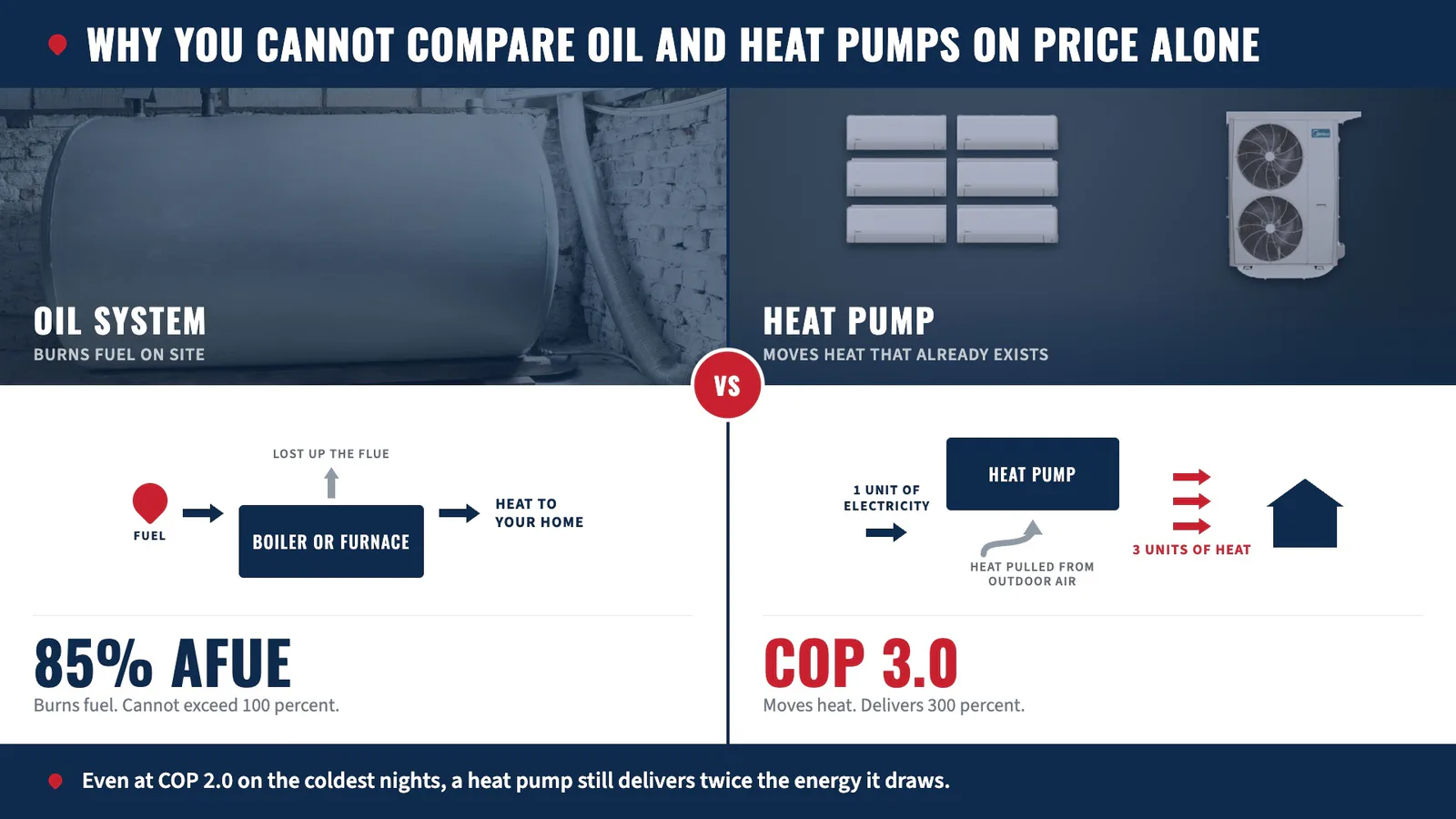
If you are still weighing whether to move off oil or propane, this rate belongs in your calculation and most online comparisons leave it out entirely.
Running a heat pump at a distribution charge of roughly two cents instead of six is a materially different proposition than what a generic calculator will show you. An independent analysis found that if the deeper discounts under consideration are approved, roughly 82 percent of households switching to heat pumps would pay less for winter heating, with median savings of about $687 a year.
The honest caveat is that homes currently on natural gas see a less clear cut benefit than homes on oil, propane, or electric resistance heat. Gas remains inexpensive per unit of energy, so the case there rests more on cooling and on where you expect fuel prices to go than on immediate winter savings.
Do It This Month
November 1 is a hard date, and enrollment takes weeks to process. The Massachusetts heat pump electric rate only starts saving you money once you are actually on it. Making one phone call in late September is the difference between a discounted heating season and finding out in February that you paid the standard rate all winter on a heat pump you installed specifically to save money.
Frequently Asked Questions
How much does the Massachusetts heat pump electric rate save?
The Department of Public Utilities estimated roughly $540 in average savings across a heating season, and utilities have put the monthly range between $70 and $140 depending on usage and provider. The discount applies to your delivery charges from November 1 through April 30 and covers all electricity your home uses in those months.
Am I enrolled automatically?
Possibly. More than 100,000 households that installed a heat pump after January 1, 2019 and received a Mass Save incentive were enrolled automatically when the rate launched. The DPU still advises calling your utility to confirm, since automatic enrollment relied on account records matching correctly. Anyone outside that group needs to enroll themselves.
Does a heat pump water heater qualify?
Not on its own. The rate requires a heat pump used for space heating. A system that heats your home and your water qualifies, but a standalone heat pump water heater does not make you eligible.
What if my town has a municipal light department?
The seasonal heat pump rate applies to residential customers of Eversource, National Grid, and Unitil. If a municipal light plant supplies your electricity, you fall outside this program and should ask your local utility about its own heat pump or efficiency offerings.
Not sure whether your system qualifies or what paperwork your utility will want? LaCroix Heating and Cooling has been installing heat pumps across Massachusetts since 2012, and we can pull the model numbers and installation records you need to get enrolled. We are a Fujitsu Elite Contractor and a Mass Save approved heat pump installer, and our installations carry a 1-year installation warranty plus 12-year manufacturer parts coverage. Call or text (508) 762-9131 and we will help you sort it out before November
-1920w_1788548006933-It7rqAr7.webp)