Two quotes are sitting on your kitchen table. One is for a Fujitsu mini split and the other for a Mitsubishi. Both promise heat on the coldest January night, and the prices are close. If you're comparing a Fujitsu vs Mitsubishi mini split for a Massachusetts home, this guide lines up each brand's leading cold climate system side by side. We install Fujitsu, so we've stuck to the official ratings listed by ENERGY STAR and the Northeast Energy Efficiency Partnerships (NEEP), and we show where Mitsubishi comes out ahead too.
The Short Answer
Neither brand wins across the board. On official ratings, Fujitsu's Orion XLTH+ beats Mitsubishi's FX Deluxe on cooling and heating efficiency, including at 5 degrees. The Mitsubishi FX wins on heating efficiency in the colder Region V rating and has the lower published indoor sound level. Both heat down to minus 22 degrees.
For most homes in Worcester and Middlesex Counties, either one will heat well below the local design temperature. That puts as much weight on the model tier and the installer as on the brand, and in 2026 the install date matters too.
Which Systems We're Comparing
A fair comparison has to match tiers, because both brands sell several lines at different prices. This guide compares two 12,000 BTU cold climate wall-mounted systems:
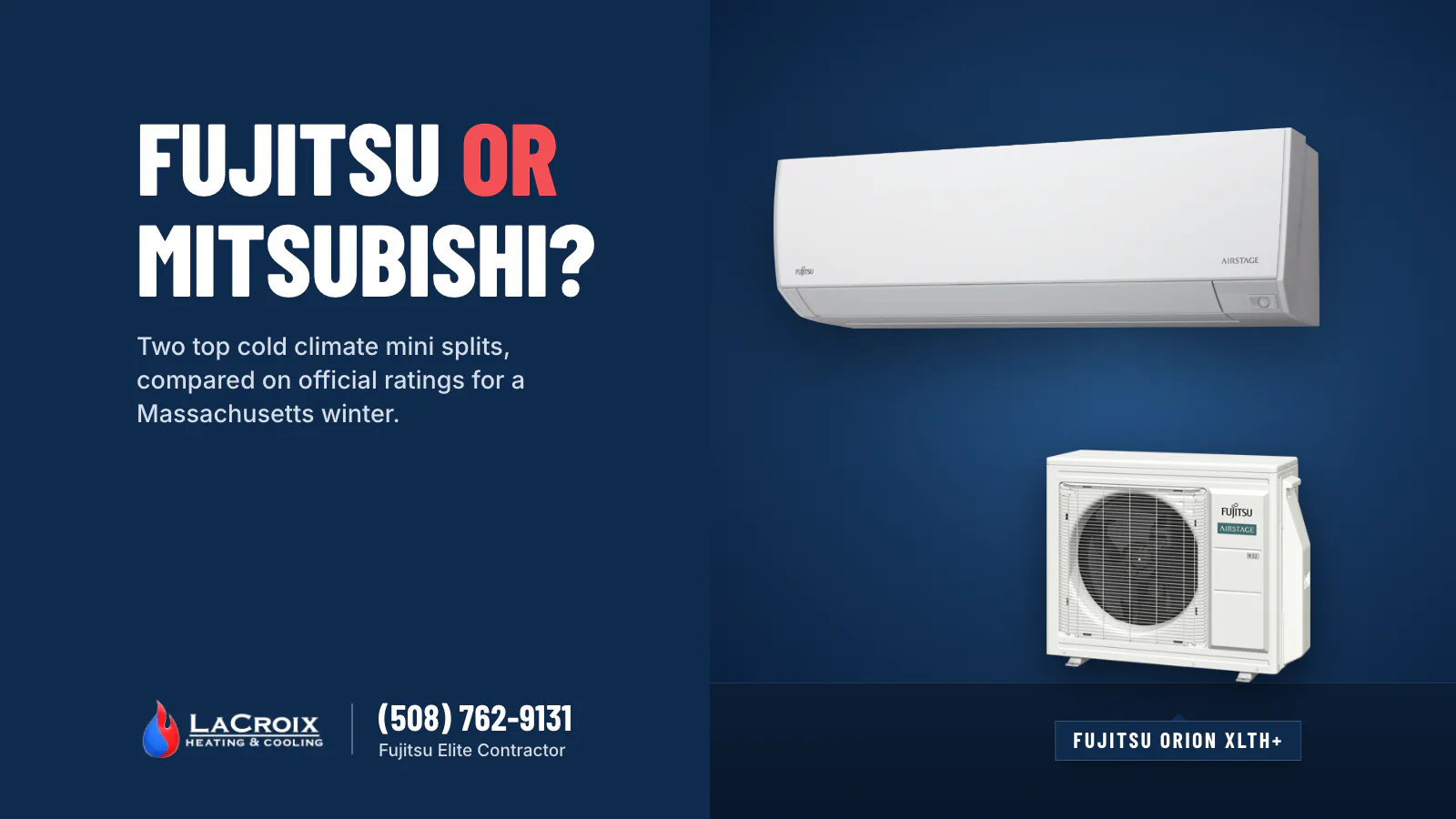
• Fujitsu AIRSTAGE Orion XLTH+: indoor unit ASUH12KTAS with outdoor unit AOUH12KTAP1. Fujitsu calls it its top tier. Fujitsu renamed its Halcyon line to AIRSTAGE in 2022, so you may see either name on a quote.
• Mitsubishi Electric FX Deluxe: indoor unit MSZ-FX12NL with outdoor unit MUZ-FX12NLHZ, which Mitsubishi pairs with its H2i hyper-heating technology.
Many quotes use a different tier. Fujitsu's Orion XLTH (outdoor unit AOUH12KZAH1) sits one step below the XLTH+ and is covered below too. Mitsubishi's GX line with a hyper-heating outdoor unit is rated well below the FX. If you're weighing a central ducted system instead, see our Midea EVOX G3 vs Mitsubishi comparison. If your two quotes are for different tiers, this comparison won't hold, so ask each installer for the exact model numbers.
Cold Weather Performance
At 5 degrees, ENERGY STAR lists both systems at 16,200 BTU per hour of rated heat. The Fujitsu XLTH+ does it with a COP of 2.62, against 2.20 for the Mitsubishi FX. COP is heat delivered per unit of electricity, so a COP of 2.62 means 2.62 units of heat for every unit of power at 5 degrees outside. NEEP's list also shows the Fujitsu's maximum output at 5 degrees at 20,500 BTU per hour, against 16,200 for the Mitsubishi, though at that maximum output its COP (2.18) is about even with the Mitsubishi's (2.20).
Both systems heat down to minus 22 degrees, and Mitsubishi says the FX delivers its full rated capacity down to minus 10. Fujitsu's step-down Orion XLTH heats down to minus 15.
ENERGY STAR's design temperature guide puts the 99 percent heating design temperature at 2 degrees for Worcester County and 1 degree for Middlesex County. That's the cold you plan for, not the coldest night ever recorded. All three systems keep running well below it, and all three list built-in base pan heaters, which keep meltwater from defrost cycles from freezing inside the outdoor unit.
Efficiency
Efficiency drives your electric bill. SEER2 measures cooling efficiency and HSPF2 measures heating efficiency, and higher is better for both. The Department of Energy rates heating efficiency for different climate regions, and Region V is the colder one.
• Cooling efficiency (SEER2): Fujitsu XLTH+ 31.5, Mitsubishi FX 29.9.
• Heating efficiency (HSPF2, Region IV): Fujitsu XLTH+ 13.7, Mitsubishi FX 12.4.
• Heating efficiency (HSPF2, Region V): Fujitsu XLTH+ 11.3, Mitsubishi FX 12.0.
Fujitsu's step-down Orion XLTH scores 30.5, 12.7 and 10.1 on the same three measures, with a COP of 2.16 at 5 degrees, just under the FX's 2.20.
Most spec sheets show the Region IV number. Region V is the more conservative figure for a Massachusetts winter, and on it the Mitsubishi FX comes out ahead of both Fujitsu tiers. Ask for the Region V number on any quote. The seasonal heat pump electric rate also lowers winter running costs for either brand.
Quiet Operation
Both are very quiet indoors. Mitsubishi lists 21 decibels for its FX indoor unit on the lowest heating fan speed. Fujitsu lists its XLTH+ indoor units as low as 23 decibels. The Mitsubishi has the lower published figure, but the two are measured at slightly different settings, so treat them as close.
Warranty: The Installer Matters More Than the Brand
The two warranties are built alike:
• Out of the box: 5 years on parts and 7 years on the compressor, for both brands.
• Registered: 10 years on parts and compressor. Fujitsu requires registration within 60 days of installation, Mitsubishi within 90.
• Installed by the brand's certified contractor: 12 years on parts and compressor. For Fujitsu that means a Fujitsu Elite Contractor. For Mitsubishi it means a Mitsubishi Diamond Contractor.
Neither warranty covers labor, so ask what your installer charges for warranty service calls. Fujitsu's warranty also excludes systems bought from online retailers, so a unit bought online is not covered, whoever installs it.
Rebates: Both Qualify, and 2027 Brings a Cut
Mass Save pays the same rebates for either brand, as long as the exact model is on the Mass Save Heat Pump Qualified Product List. All three systems in this comparison are on it. For systems installed by December 31, 2026, Mass Save pays up to $2,650 per ton, capped at $8,500, for a whole home system. When you keep your existing heating system as backup, it pays up to $1,125 per ton, also capped at $8,500.
Those rates drop for installs on or after January 1, 2027, to up to $2,350 per ton for whole home and up to $1,000 per ton for partial home, both capped at $7,500, verified as of October 2026.
If you keep oil, propane, or gas heat in any zone, Mass Save also requires an integrated control from its qualified list for that zone. That control decides when the heat pump runs and when the old system takes over. Mass Save also requires an installer in its Heat Pump Installer Network.
Older models from both brands used R-410A refrigerant, and since January 1, 2026, R-410A systems are no longer on Mass Save's list. If a quote or an online deal looks unusually cheap, check the refrigerant. The current Fujitsu models use R-32 and the current Mitsubishi uses R-454B.
The New England Heat Pump Accelerator adds an instant discount of up to $650 per qualifying outdoor unit, limited to two per home, for existing homes rather than new construction, verified as of October 2026. Your installer arranges it through a participating distributor, and it stacks with Mass Save.
Multi-Zone Systems
For homes that need several indoor units on one outdoor unit, the published ratings are close. Fujitsu rates its Aquila XLTH multi-zone outdoor units, for two to four rooms, to heat down to minus 15 degrees. Mitsubishi rates its hyper-heating multi-zone outdoor units to heat in outdoor temperatures as low as minus 13 degrees.
How to Choose for Your House
Skip the brand debate and start with these questions:
• Which tier is the quote for? Compare Fujitsu's Orion XLTH+ against Mitsubishi's FX, and expect the Orion XLTH to trade wins with the FX rather than beat it.
• Was the system sized with a load calculation? For a whole home rebate, Mass Save requires the heat pump to cover 90 to 120 percent of the home's heating load at the outdoor design temperature.
• Is the installer in the Mass Save Heat Pump Installer Network, and certified by the brand? You need the first for the rebate and the second for the 12-year warranty.
• Can it be installed before January 1? The 2026 rebate rates are higher.
The Bottom Line on Fujitsu vs Mitsubishi Mini Splits
In a Fujitsu vs Mitsubishi mini split decision, neither brand is a wrong choice at this level. Fujitsu's Orion XLTH+ leads on most published efficiency ratings, and Mitsubishi's FX holds the edge on Region V heating efficiency and published indoor sound. One tier down, Fujitsu's Orion XLTH edges the FX on cooling and Region IV efficiency, but the FX leads clearly on Region V heating efficiency (12.0 vs 10.1) and is rated for deeper cold. Choose the system and the installer together, because the warranty and the quality of the install depend on that pairing.
We're a Fujitsu Elite Contractor, a status Fujitsu awards based on training and product registrations, so Fujitsu is the ductless line we're certified on. Systems we install and register on time carry Fujitsu's full 12-year parts and compressor coverage.
Frequently Asked Questions
Is Fujitsu as good as Mitsubishi for cold climates?
Yes. Fujitsu's Orion XLTH+ heats down to minus 22 degrees like Mitsubishi's FX, and ENERGY STAR rates it more efficient at 5 degrees. Mitsubishi's FX has the higher Region V heating efficiency rating. Fujitsu's step-down Orion XLTH heats to minus 15. All three run well below the roughly 1 to 2 degree design temperature in Worcester and Middlesex Counties.
Which is more reliable, Fujitsu or Mitsubishi?
We couldn't find failure rate data published by either brand, so there's no official way to rank them. Both back their cold climate systems with the same 12-year length of parts and compressor coverage when a certified contractor installs and registers them, with slightly different registration rules. In practice, the quality of the installation and access to local service matter more than the logo.
Do Fujitsu and Mitsubishi mini splits qualify for Mass Save rebates?
Their current cold climate models do, as long as the exact model is on the Mass Save Heat Pump Qualified Product List. For installs by December 31, 2026, Mass Save pays up to $2,650 per ton for whole home systems, capped at $8,500. That drops to up to $2,350 per ton, capped at $7,500, for installs from January 1, 2027, verified as of October 2026.
Do I need a Mass Save approved installer?
Yes. Mass Save requires the system to be installed by a contractor in its Heat Pump Installer Network, or the rebate doesn't apply. For the 12-year manufacturer warranty, you also want an installer certified by the brand you choose.
Comparing quotes for a ductless system? LaCroix Heating and Cooling has installed heat pumps for homeowners across Worcester and Middlesex Counties since 2012. We are a Fujitsu Elite Contractor and a Mass Save approved heat pump installer, and our work carries a 1 year installation warranty plus 12 year manufacturer parts coverage. Call or text (508) 762-9131.