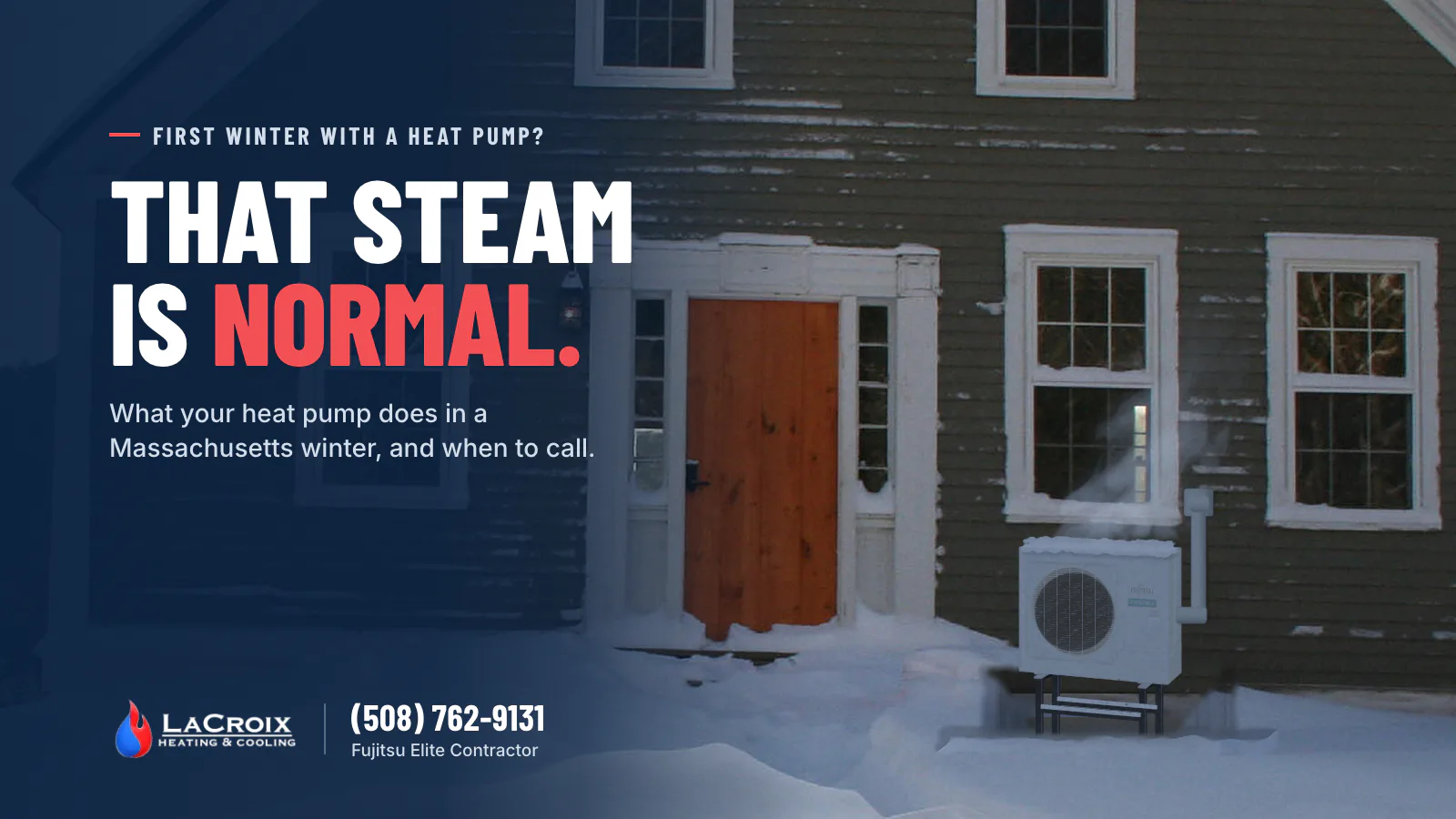
It's 6 AM on a January morning and the thermometer on the porch reads single digits. You look out the kitchen window and the outdoor unit's fan has stopped, with a plume of white vapor drifting across the yard. It looks like something broke. It almost certainly didn't.
A heat pump in winter behaves differently from the furnace or boiler most Massachusetts homeowners grew up with. Steam from the outdoor unit, light frost on the coil, air that feels cool at the register, and nearly nonstop running are all normal. Call a technician if the unit is encased in ice, or if rooms keep falling behind the thermostat in mild weather.
Why Your Heat Pump Blows Cooler Air and Runs All Day
A furnace heats in bursts, firing hard and then shutting off. A Mass Save homeowner guide puts furnace supply air at around 120 to 160 degrees, while heat pump supply air typically runs about 85 to 105 degrees, depending on outdoor conditions.
That gap explains two things people notice right away. Hold your hand to a register and the air can feel cool against your skin, even though it's warmer than the room and steadily heating it. And the system seems to run all the time.
Both are by design. The Northeast Energy Efficiency Partnerships (NEEP), a regional efficiency group, says in its consumer guide that cold climate heat pumps are designed to run almost continuously at a very low level, and the lower the speed, the more efficient they are. Mass Save's guide is blunter: if your heat pump seems to always be on, that's often a sign it's working correctly.
The same guide notes that air from the indoor unit may get cooler as the outdoor temperature drops. That's expected too, as long as the house holds the temperature you set.
The Defrost Cycle: Why Your Heat Pump Steams in Winter
When the outdoor coil drops below freezing and the air is humid, moisture freezes onto it as frost. Frost blocks airflow, so the system periodically clears it. The refrigerant flow briefly reverses to warm the outdoor coil, and the frost melts off.
Here is what that looks like:
• The outdoor fan may stop, and steam or vapor may rise from the unit. Fujitsu's support pages describe exactly this and attribute it to automatic defrosting.
• The cycle typically lasts about 5 to 15 minutes, according to a heat pump owner guide from the Consortium for Energy Efficiency (CEE).
• On a ductless system, the indoor fan may slow or stop to avoid blowing cold air into the room. On many Fujitsu indoor units, the operation light blinks.
• You may hear new sounds. Fujitsu lists an occasional sizzling sound during defrost as normal, and NEEP lists gurgling or swishing from ductless indoor units during defrost.
• On a ducted system, supplemental heat may come on briefly to cover the gap.
The meltwater drips out the bottom of the outdoor unit. Fujitsu's XLTH units include a base heater that kicks on at 36 degrees so that water doesn't refreeze inside the base.
When defrost is not normal
Fujitsu's defrost explainer says a check may be warranted when the system defrosts again and again with very little heating in between, or when the coil stays heavily iced after a cycle ends.
Frost Is Normal. A Heat Pump Iced Over Is Not.
A light coating of frost on the outdoor coil on a damp morning is routine. The CEE guide notes the coils may get a bit frosted but will clear themselves. What you shouldn't see is a unit encased in ice, or ice that's still there long after a defrost cycle. CEE's advice is direct: if your heat pump is stuck in defrost or covered in ice, call an HVAC professional.
Ice can also come from above rather than from the unit itself. The same guide warns that a unit sitting under a roof's drip line can have snow and water problems that affect airflow.
Keep snow shoveled away from the unit. NEEP's installation guide calls for clearance above your area's average maximum snow depth, so if drifts reach the coil, ask about a taller stand. It also advises keeping units away from walkways, where defrost meltwater can refreeze into a slip hazard. Our pre-winter heating checklist covers the rest of the fall prep.
Heat Pump Thermostat Settings for Winter
Many households turn the heat down at night and back up in the morning. With a furnace, that saves fuel. With a heat pump, it can cost you.
Mass Save's guidance is to keep the thermostat at a steady setting, or use small setbacks of 2 to 3 degrees at most. NEEP also warns that deep setbacks on cold climate heat pumps may cost you energy and money, and it says not to shut a heat pump off in very cold weather.
The reason is recovery. When you ask a heat pump to climb 8 degrees at 6 AM, the system may bring on its backup heat to get there, and backup heat is far less efficient. CEE's guide advises against abrupt temperature changes, because rapid adjustments can prompt inefficient operation and raise costs. If you want a schedule, use a thermostat built for heat pumps. The Department of Energy has described these as typically using special algorithms to minimize backup electric resistance heat.
Auxiliary Heat vs Emergency Heat
Auxiliary heat is automatic. On a ducted system, it's usually electric resistance strips that supplement the heat pump when it can't keep up alone, such as during defrost or a big temperature recovery. CEE describes strip heat as costly and inefficient, which is why you want it running as little as possible. Aux heat showing during a defrost or a morning recovery is normal. If it's displayed on the thermostat constantly, CEE lists that as a reason to call a professional.
Emergency heat is manual. Honeywell's support pages say it locks out the heat pump's compressor so only backup heat runs, and Google's Nest help center says running it is usually expensive and inefficient. You shouldn't need it often. Switch it on if the outdoor unit is damaged or a technician tells you to.
If your backup is a gas furnace or an oil system, your installer may have set it to take over below a chosen outdoor temperature, so long runs on the coldest days can be normal. If it runs a lot in mild weather, ask to have the settings checked. Massachusetts law also requires carbon monoxide alarms in homes with fossil fuel equipment, so test yours.
How Cold Is Too Cold for a Heat Pump
On the coldest night of the year, a properly sized cold climate system should keep up, possibly with help from backup heat.
Most air source heat pumps lose some capacity as the outdoor temperature falls, since there's less heat in the air to move. ENERGY STAR's Cold Climate designation requires a unit to keep at least 70 percent of its 47 degree heating capacity when it's 5 degrees out. It also has to deliver a COP of at least 1.75 at 5 degrees, meaning 1.75 units of heat for every unit of electricity.
Some current cold climate models are rated well beyond that 5 degree test. Midea rates its EVOX G3 central heat pump for up to 100 percent heating output at minus 13 degrees. Fujitsu's top tier Orion XLTH+ mini split heats down to minus 22 degrees, and the step-down Orion XLTH to minus 15.
A system that falls behind on a 30 degree day is a different story.
Signs Your Heat Pump in Winter Needs a Technician
Most winter surprises are normal operation. Mass Save's guide for new owners says to contact your installer when the system can't hold a reasonable indoor temperature, makes unusual noises, shows repeated error codes, or runs up bills that seem too high for the weather. Call if you see any of these:
• The outdoor unit is encased in ice, or stays iced after a defrost cycle ends.
• The system goes into defrost again and again with little heating in between.
• Aux heat shows on the thermostat constantly.
• Rooms keep falling behind the thermostat in mild weather.
• You hear grinding, banging, or scraping rather than the defrost sounds described above.
If the bill looks high, confirm you're on the seasonal heat pump electric rate. Eversource, National Grid, and Unitil apply a lower rate to all household electricity from November 1 through April 30 for homes that heat with a heat pump, verified as of October 2026. If your town has a municipal light plant, ask it about heat pump offers instead.
Most of what looks wrong with a heat pump in winter is normal. Call when the house can't hold its temperature or the ice won't clear after a defrost.
Frequently Asked Questions
Why is my heat pump blowing cold air in winter?
Heat pump air usually comes out around 85 to 105 degrees, which feels cool against your hand compared with a furnace. During a defrost cycle, the indoor fan may slow or stop, and CEE notes that a ductless indoor unit may put out some cool air while the outdoor coil warms. If the house is losing temperature, that's a different problem and worth a call.
Why is steam coming out of my heat pump?
That's usually the defrost cycle. The system briefly reverses to melt frost off the outdoor coil, and while it does, the outdoor fan may stop and vapor may rise from the unit. It typically lasts about 5 to 15 minutes, then normal heating resumes.
Should I cover my heat pump in winter?
No. NEEP's consumer guide warns against covering or hiding the outdoor unit. A heat pump runs all winter and needs open airflow around the coil. Keep snow shoveled away from it instead. If roof water drips onto it, fix the gutter or ask your installer about a manufacturer approved drip shield.
When should I use emergency heat?
Rarely. Emergency heat shuts off the heat pump and runs only the backup heat, so it's for when the heat pump has stopped working, such as when the outdoor unit is damaged, or when a technician tells you to use it. Running it is usually expensive and inefficient.
Talk to a Local Heat Pump Installer
Want a second opinion on how your system is handling the cold? LaCroix Heating and Cooling installs heat pumps for homeowners across Worcester and Middlesex Counties. We are a Fujitsu Elite Contractor and a Mass Save approved heat pump installer, and our work carries a 1 year installation warranty plus 12 year manufacturer parts coverage. Call or text (508) 762-9131.