
The mornings have started to bite. You have probably already had one where you thought about closing the window and decided to tough it out instead. Somewhere in the next six weeks you are going to reach for the thermostat for the first time since spring, and that moment is where a lot of Massachusetts homeowners find out something is wrong. Working through a pre-winter heating checklist now, while the weather is still forgiving, is the difference between a scheduled repair and an emergency call on the first freezing night in November. Here is what to do, in the order that makes sense.
Why Early September Beats Mid October
Every heating contractor in Massachusetts has the same calendar. It is quiet through September, then the first genuinely cold week arrives and the phones do not stop for two months.
Booking now buys you three things worth having. You get your pick of appointment times instead of whatever is left. If a technician finds a worn part, there is time to order it rather than improvise. And if the news is bigger, like a heat exchanger crack or a system at the end of its life, you get to make that decision calmly in October rather than under pressure with the house at 52 degrees.
There is a financial angle too. If a replacement ends up on the table, Massachusetts rebate paperwork and equipment ordering both take time. Starting that conversation in September means you are installed before the cold rather than during it.
The Part You Can Do This Weekend
None of this requires tools you do not already own.
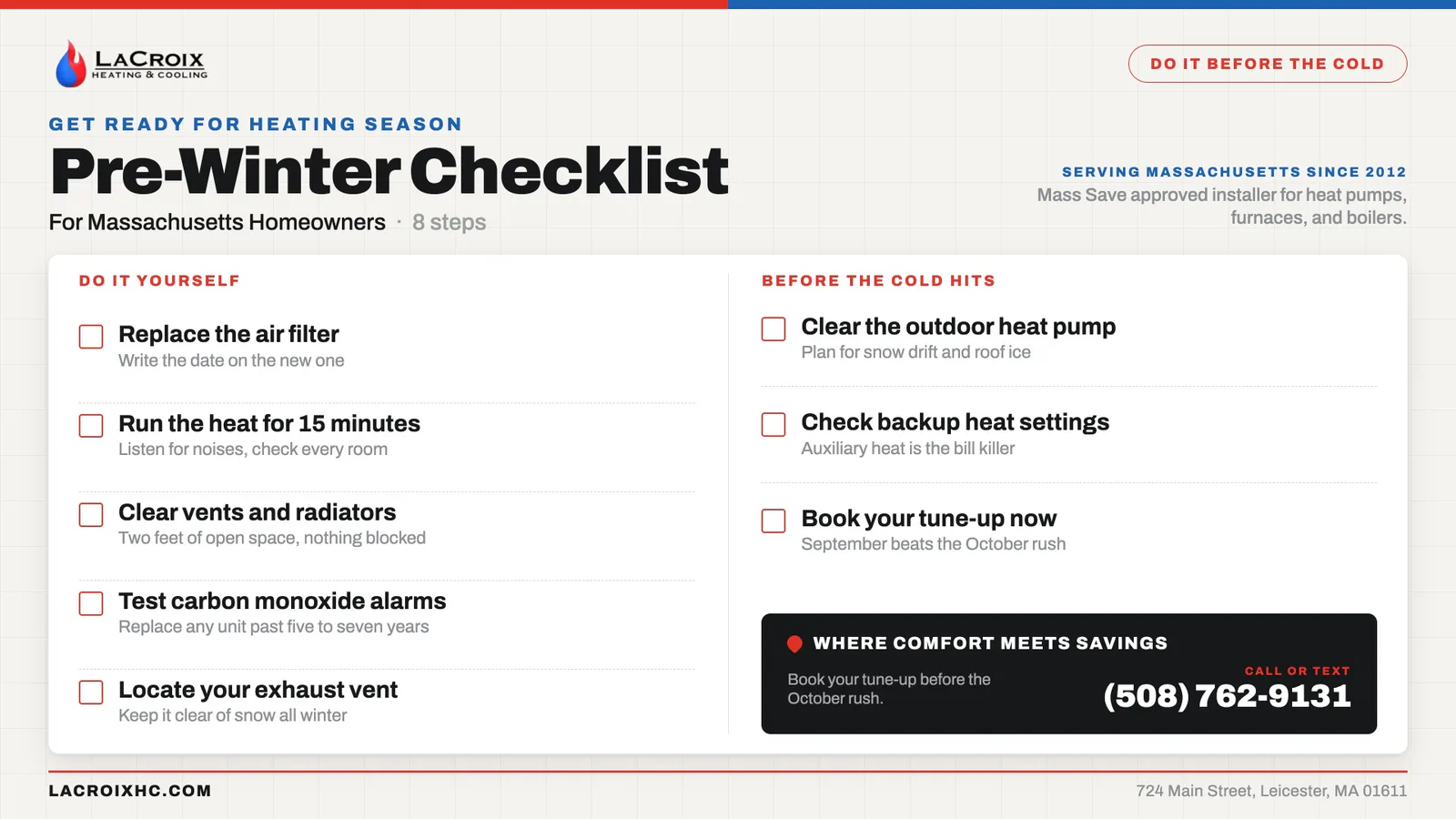
Replace the filter. If it has been in since spring, it is done. A clogged filter chokes airflow, makes the system work harder, and is the single most common cause of heating complaints. Write the date on the edge of the new one with a marker so you are not guessing next time.
Run the heat for fifteen minutes. Do this on purpose, on a mild day, while it is still easy to get help. Turn the thermostat up until the system kicks on and let it run. You are listening for grinding, banging, or a burning smell that lasts more than a few minutes, and you are checking that every room actually gets warm air. Finding a problem now is a scheduling matter. Finding it in December is an emergency.
Walk the vents and radiators. Furniture gets moved over the summer, rugs shift, and returns end up blocked behind a couch. Every supply and return needs clear space. Closing vents in unused rooms does not save money on most systems and can raise pressure in the ductwork.
Test the carbon monoxide detectors. If you heat with gas, oil, or propane, this is not optional. Massachusetts requires CO alarms on every level of a home with fuel-burning equipment. Press the test button on each one. CO alarms have a service life of roughly five to seven years depending on the model, and the sensor degrades on that schedule whether or not the battery is fine, so check the manufacture date printed on the back and replace anything past it.
Find your exhaust vent and remember where it is. If you have a high efficiency furnace, boiler, or tankless water heater, it vents through a plastic pipe out the side of your house rather than up a chimney. That pipe has to stay clear all winter. Massachusetts law on carbon monoxide alarms exists because of a 2005 case in Plymouth where a family lost a seven year old child after snow blocked the furnace vents and filled the house with carbon monoxide. Walk outside now, find your vent, and make a note to check it after every heavy snow and whenever a plow berm or a roof slide piles up against the house.
Look at the thermostat schedule. Many people set a summer schedule in June and forget it. Check that your program matches how you actually use the house now, and change the batteries if it takes them.
If You Heat With a Heat Pump, Add These
Heat pump owners have a slightly different list, and most generic fall checklists skip it entirely.
Clear the outdoor unit and plan for snow. Your heat pump runs all winter, which means the outdoor unit needs to breathe when there is snow on the ground. Cut back anything that has grown around it over the summer and leave at least two feet clear on all sides, which is the industry installation standard. If the unit sits on a low pad, ask your installer about raising it, since the guidance for snowy regions is to get the base roughly a foot above the highest snow depth you typically see. An open bottom stand works better than a solid one because wind scours underneath instead of letting snow pack in. Also look at what is above the unit, because ice sliding off a roofline does real damage, and clear any large icicles forming on the eave overhead.
Understand your defrost cycle before it surprises you. On a cold damp day your heat pump will periodically reverse itself to melt frost off the outdoor coil. You may see steam, hear a whoosh, and notice the fan stop. That is the system working correctly, not failing. Homeowners in their first winter with a heat pump call about this constantly.
Check how your backup heat is set up. If you have auxiliary electric heat or a dual fuel setup with a furnace, confirm the changeover settings are sensible. Backup heat running when it does not need to is one of the fastest ways to a shocking January electric bill.
Know about the winter heat pump rate. Massachusetts electric utilities offer a discounted seasonal rate for homes heating with heat pumps, running roughly November through April. Many customers who installed through a Mass Save incentive were enrolled automatically, but it is worth confirming with your utility rather than assuming, verified as of September 2026.
What a Professional Tune-Up Actually Covers
A real tune-up is not someone glancing at your system and handing you an invoice. On a fuel-burning system a technician should be checking the heat exchanger for cracks, testing combustion and draft, inspecting the flue, cleaning the burners, verifying gas pressure, and confirming the safety controls shut the system down when they should. Heat exchanger inspection is the one that matters most, because a crack can put combustion gases into your living space and you will not smell it happening.
On a heat pump, the work looks different. Refrigerant charge gets verified, both coils get inspected and cleaned, the reversing valve and defrost board get tested, electrical connections get tightened, and the technician should confirm the system delivers its rated output rather than quietly leaning on backup heat to keep up.
Expect a tune-up to run somewhere in the range of $70 to $200 depending on the system and the depth of the visit, verified as of September 2026. If a quote sits well below that, ask exactly which checks are included.
The Envelope Matters as Much as the Equipment
A well-maintained heating system in a leaky house still costs a fortune to run. Before winter, check the obvious weak points: weatherstripping on exterior doors, the attic hatch, gaps around window frames, and the rim joist in the basement where the framing meets the foundation.
This is also worth a call to Mass Save. A no-cost home energy assessment will identify where your house is losing heat, and the program covers a large share of qualifying insulation and air sealing work. Sealing the envelope before the cold arrives lowers your bills all winter, and if a heat pump is anywhere in your future, weatherization affects both the equipment size you need and your rebate eligibility.
Working the Pre-Winter Heating Checklist Into Your September
None of this takes long. Give it an hour on a Saturday for the homeowner tasks, then make one phone call to get the professional visit on the calendar before the rush starts. The homes that go through winter without a heating emergency are usually not the ones with the newest equipment. They are the ones where somebody looked at the system in September instead of hoping for the best in December.
Frequently Asked Questions
When should I schedule a heating tune-up in Massachusetts?
September through early October is ideal. Contractor schedules are open, parts can be ordered without delay, and any larger decision can be made calmly. Once the first hard cold arrives, availability tightens quickly and you are competing with emergency calls.
Do heat pumps need maintenance before winter like furnaces do?
Yes, though the work differs. A heat pump tune-up covers refrigerant charge, coil condition, the reversing valve, defrost operation, and electrical connections. Heat pumps also need clearance around the outdoor unit for winter airflow and snow, which furnaces do not require since their equipment sits indoors.
How much does a heating tune-up cost?
Most fall tune-ups in Massachusetts run roughly $70 to $200 depending on the system type and how thorough the visit is, verified as of September 2026. Prices well below that range usually mean a shorter visit, so ask which specific checks are covered before booking.
Is my heat pump broken if it blows steam in the winter?
No. That is the defrost cycle, where the system briefly reverses to melt frost from the outdoor coil. You may see vapor rising, hear the fan stop, and notice a change in sound. It lasts a few minutes and then normal heating resumes. Frequent or very long defrost cycles are worth having checked.
Want your system looked at before the calendar fills up? LaCroix Heating and Cooling has been keeping Massachusetts homes warm since 2012, and we service furnaces, boilers, and heat pumps with the same attention. We are a Fujitsu Elite Contractor and a Mass Save approved heat pump installer, and our installations carry a 1-year installation warranty plus 12-year manufacturer parts coverage. Call or text (508) 762-9131 to get on the schedule

-1920w_1788548006933-It7rqAr7.webp)