Water heaters tend to get replaced in a hurry, the morning the tank starts leaking or the shower goes cold. When that happens, it's easy to end up with the same kind of tank you had before.
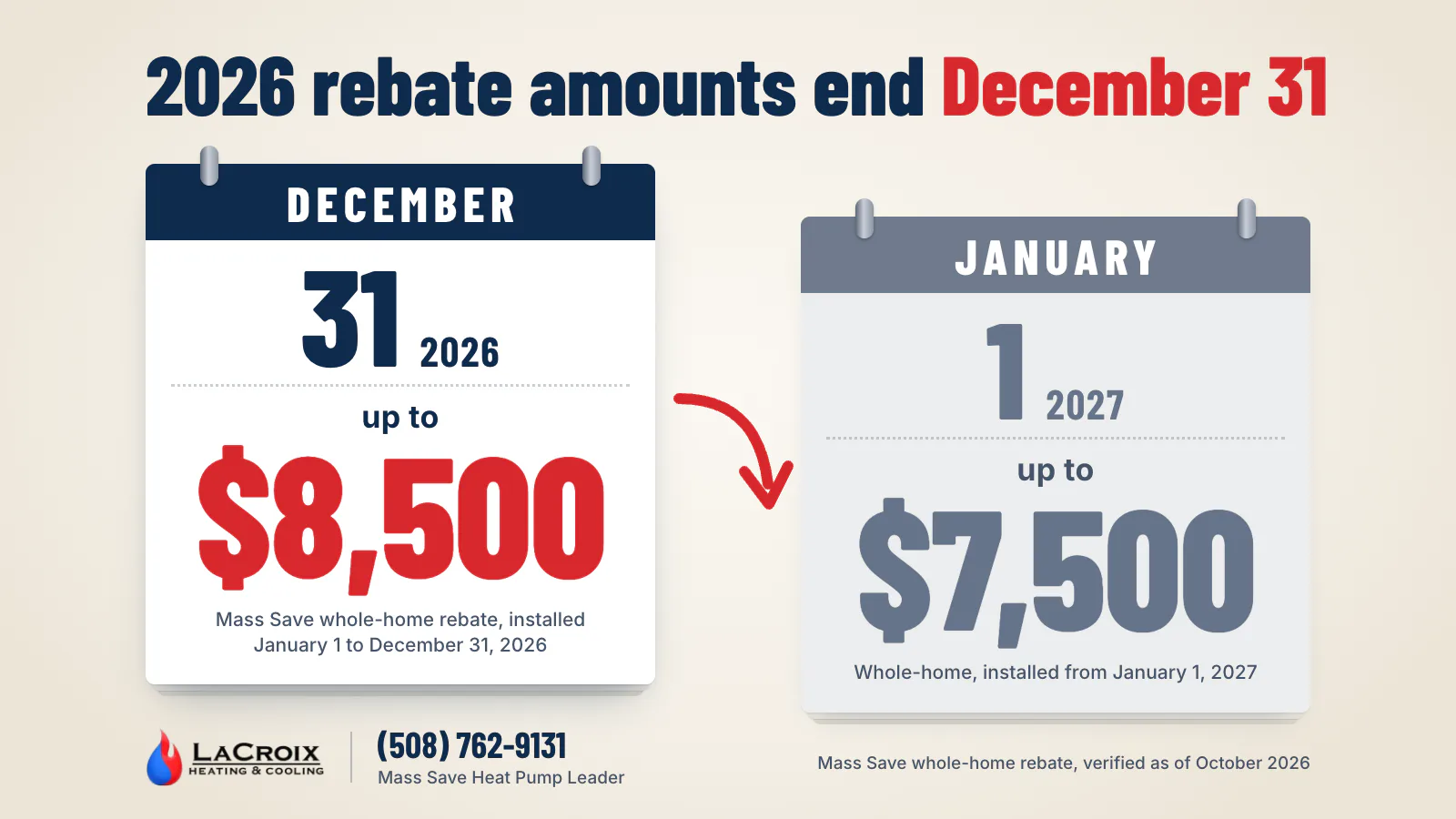
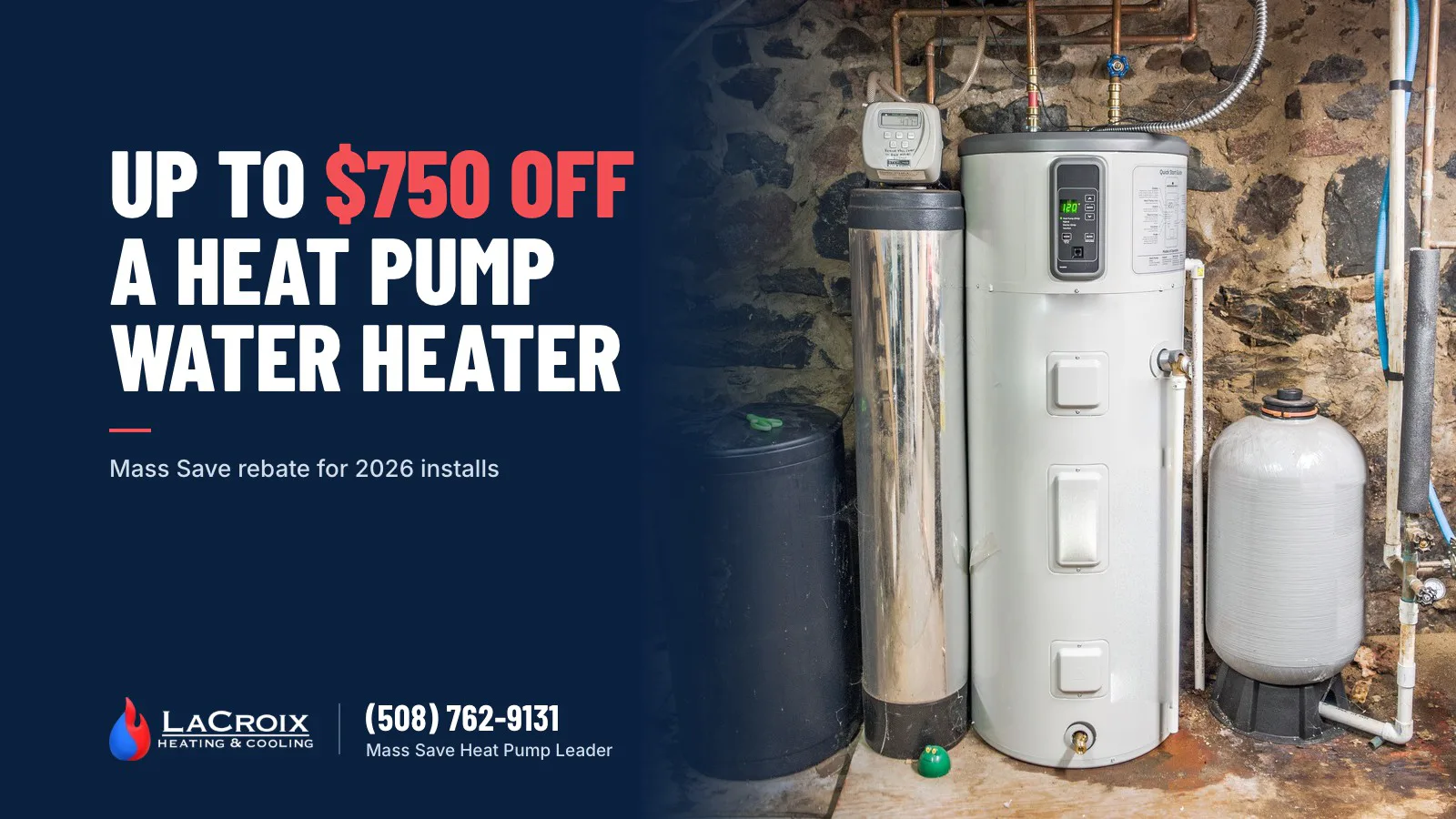
If yours is getting on in years, you have time to do it differently. Have a heat pump water heater in Massachusetts put in by December 31, 2026, and it can qualify for a Mass Save rebate of up to $750. It also uses far less electricity than a standard electric tank. But not every basement suits one.
How a Heat Pump Water Heater Works
A standard electric tank is basically a big kettle. Electric elements heat the water directly. A heat pump model pulls heat out of the surrounding air and moves it into the tank instead. Moving heat takes much less energy than making it, and an ENERGY STAR certified one uses about a quarter of the energy a standard electric water heater does.
Taking heat from the room leaves it a little cooler and drier. In a damp Massachusetts basement, the drier air can be a plus.
Starting From Gas, Oil, or Electric
Just over half of Massachusetts homes, 52 percent, heat their water with natural gas. Electricity is next at 30 percent, then oil or kerosene at 15 percent.
Electric tanks are where the savings are easiest to see. Our water heater page has a savings calculator if you want a rough number for your household.
Mass Save stopped offering rebates on new gas water heaters in 2024, except for income-eligible customers. You can still get the heat pump rebate when you replace a gas unit. Switching from gas adds to your electric bill, though, and you'll usually save less on running costs than you would replacing an electric tank. If your gas unit is newer and high-efficiency, the savings may be small.
The rebate also covers replacing an oil-fired water heater. If you're thinking about getting the whole house off oil, our oil to heat pump guide walks through it.
The 2026 Mass Save Rebate
Mass Save offers up to $750 for a qualifying ENERGY STAR certified heat pump water heater installed in 2026. Split-system models can get up to $1,500.
It's for replacing an existing electric, propane, natural gas, or oil water heater, and a licensed plumber needs to do the install. The unit must be bought and installed between January 1 and December 31, 2026. Online and mail-in claims have to arrive by February 28, 2027, and it's one rebate per account.
Your plumber can take the rebate as an instant discount when buying from a participating distributor. At a participating retailer, it comes off at the register once you get a code at MassSave.com/Instant. Otherwise, you apply online or by mail after the install.
Mass Save hasn't announced a 2027 amount, so for now, plan around the 2026 rebate. If you're cutting it close, our post on the Mass Save rebate deadline explains how a December 31 cutoff plays out.
Other Discounts and Financing
The New England Heat Pump Accelerator offers up to $300 on a qualifying unit, one per home, and it stacks with the Mass Save rebate. It comes off the price when the unit is bought through a participating distributor. We'll check whether it's still available when we quote your job.
If you'd rather spread out the cost, the Mass Save HEAT Loan gives you 0 percent financing up to $25,000, and these units qualify. You can skip the home energy assessment for this one. Just get the loan approved before the install.
Some towns run their own electric company. If yours does, you can get the Mass Save rebate and HEAT Loan only when your home is heated with natural gas from a gas company in Mass Save. You can still get the Accelerator discount of up to $300.
In those towns, if Mass Save is off the table, there's the state's newer Z-Loan. It's 0 percent financing up to $25,000, paid back over as long as five years, for upgrades that include energy-efficient water heaters. You'll start with a home energy assessment and need lender approval before any work begins.
The federal tax credit won't help, since it doesn't cover anything installed after 2025. And a water heater alone won't get you onto the seasonal heat pump electric rate, which is for homes heated by a heat pump.
What Your Basement Needs
Most standard 240-volt models need at least 700 cubic feet of air around them to pull heat from. That's roughly a 10 by 10 foot room with a 7 foot ceiling. Some models need as little as 450 cubic feet. In a smaller room or closet, a louvered door or a venting kit can make it work, depending on the model.
They also run well in a space that stays between 40 and 90 degrees all year. An unheated room that gets near freezing in January is a poor spot. The Rinnai models we recommend run in heat pump mode down to 37 degrees. Below that, the built-in electric element takes over. You still get hot water, just not the heat pump savings.
As the unit runs, it pulls water out of the air. That condensate needs a floor drain nearby or a small pump. Most models need a 240-volt circuit, typically on a 30-amp breaker. There are 120-volt plug-in models for gas replacements, but you'll usually need a tank two sizes bigger than the old gas one.
The Rinnai Models We Recommend
Rinnai makes them in 50, 65, and 80 gallon sizes. The 50 gallon is rated 3.75 UEF, the 65 is 3.90, and the 80 is 4.00. A higher UEF means a more efficient tank. All three run on 240 volts with a 30-amp breaker, and Rinnai doesn't make a plug-in version.
We size the tank by how your household actually uses hot water, not just by the old tank's gallons. We look at the first-hour rating, meaning how much hot water it can put out in a busy hour, and at how fast it heats back up.
When It Makes Sense for Your Home
A heat pump water heater in Massachusetts tends to pay off when you're replacing an electric tank and have a basement or utility room with enough space. A qualifying unit installed in 2026 is eligible for the Mass Save rebate of up to $750. It's a closer call in a tight closet or a space that gets very cold. We can look at your space with you before you buy.
Frequently Asked Questions
Will a heat pump water heater make my basement colder?
A little. It drops the room about 2 degrees on average and dries the air. In a space that's already chilly in winter, plan for that small drop.
Are heat pump water heaters noisy?
They make a steady hum while the heat pump runs, about 45 to 60 decibels on most new models. A utility area is a better spot for one than the space right under a bedroom.
Do heat pump water heaters need to be vented?
No flue or chimney, since nothing burns. But they do need air: at least 700 cubic feet for most standard models, or a louvered door or venting kit in a smaller space. They also need a drain or pump for the condensate.
How long does a heat pump water heater last?
Usually 13 to 15 years. Rinnai's models carry a 10-year limited warranty on the tank and parts.
Talk to Us About Your Water Heater
If you want a new water heater in before the year's out, give us a call. LaCroix Heating and Cooling serves Worcester and Middlesex Counties, and our office staff can walk you through the Mass Save rebate. We're a Mass Save Heat Pump Leader. Our installs come with a 1-year installation warranty on top of the manufacturer's coverage. Our number is (508) 762-9131, or you can contact us online.