Your first fuel delivery of the season is coming, probably this month or next. You know roughly what the winter is going to cost because you have been doing this for years, and every fall you have the same passing thought about whether there is a better way to heat the house. An oil to heat pump conversion is the version of that thought most Massachusetts homeowners eventually take seriously, and September is when the decision actually has to happen if you want it done before the cold. Here is how it works and who it makes sense for.
Why This Question Comes Up So Often Here
Massachusetts is the second largest heating oil market in the country. Somewhere between a fifth and a third of homes in the state still heat with oil depending on which survey you read, and the concentration is heaviest in older housing stock and in the smaller towns where gas mains never ran down every street. Propane fills in much of the rest.
If your house is one of them, you are likely on your second or third oil system, buying fuel at a delivered price you have no control over. Cold climate heat pumps gave those homes a real alternative for the first time, and the Massachusetts incentive structure changed the math on top of it.
How to Compare Running Costs Honestly
Most comparisons you will find online are useless because they compare a price per gallon to a price per kilowatt hour, which are not comparable units. Here is the method that actually works.
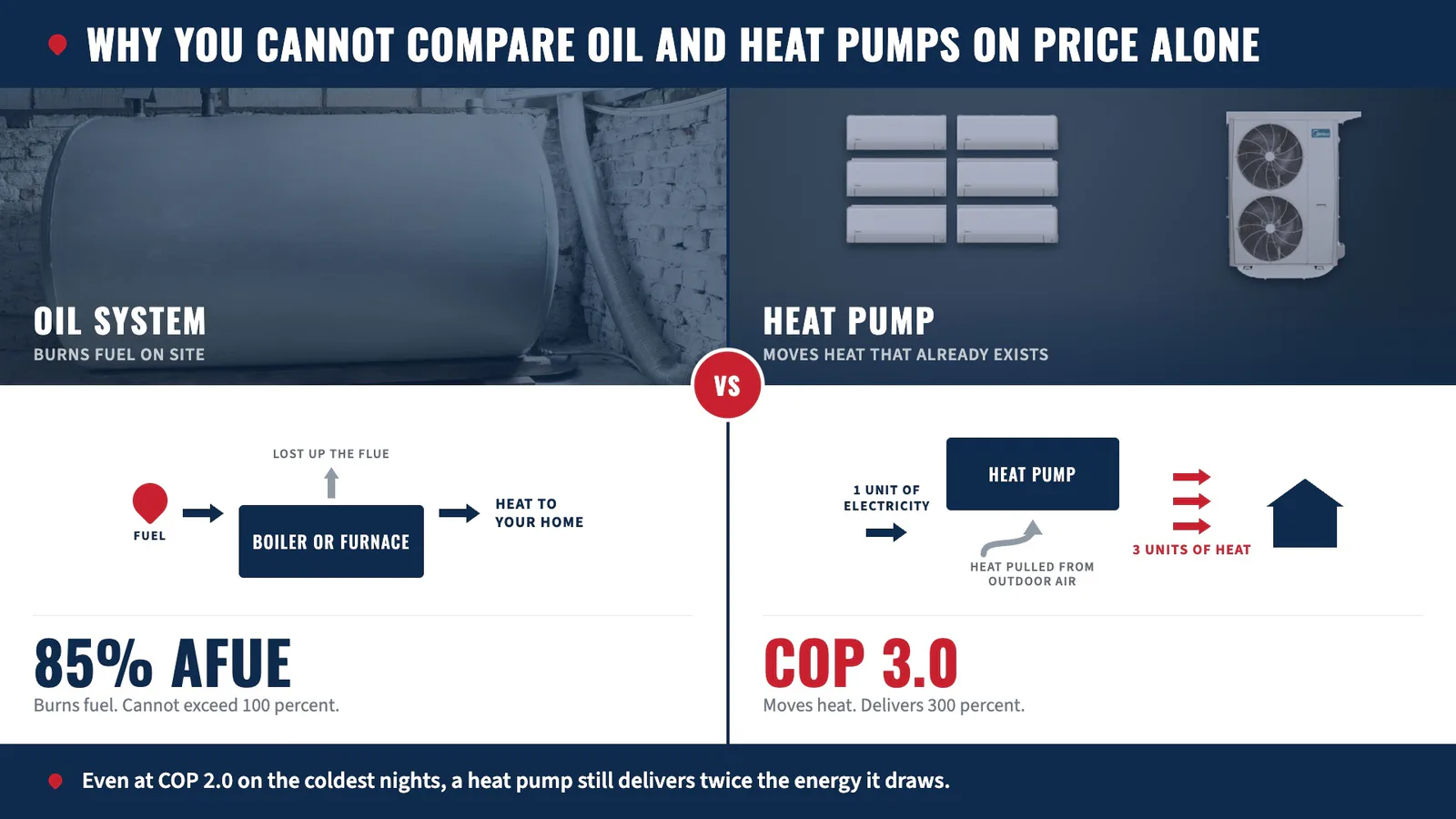
An oil boiler or furnace turns fuel into heat at its rated efficiency. A system rated 85 percent AFUE delivers 85 percent of the energy in the fuel as usable heat and sends the rest up the flue. That is the ceiling. No fuel burning appliance exceeds 100 percent.
A heat pump does not create heat, it moves it, which is why its efficiency is expressed as a coefficient of performance rather than a percentage. A COP of 3.0 means three units of heat delivered for every unit of electricity consumed, or 300 percent. Even on a genuinely cold Massachusetts night when the COP drops closer to 2, the system is still delivering twice the energy it draws.
To compare the two, you need three current numbers: what you actually pay per gallon delivered, what you actually pay per kilowatt hour including delivery charges, and the realistic seasonal efficiency of each system. Then convert both to a cost per unit of useful heat.
Do not take fuel prices from a comparison site. The Department of Energy Resources surveys oil and propane dealers across Massachusetts and publishes the average retail price weekly through the heating season, and that dashboard on mass.gov is the number to use. Aggregator sites routinely quote well above the state survey average, and an inflated fuel price corrupts the whole calculation. Your electric rate is on your own bill, where the delivery portion matters as much as supply.
The Number That Changes Everything for Heat Pump Owners
Massachusetts electric utilities now offer a discounted seasonal rate for homes heating with heat pumps, running roughly November through April. That rate is the single most important variable in a conversion calculation, and most online comparisons predate it entirely.
If you run the numbers using your standard year round electric rate, you will understate the case for conversion. Many customers who installed through a Mass Save incentive were enrolled automatically, but confirm with your utility rather than assuming, verified as of September 2026.
What the Conversion Actually Involves
This is where quotes diverge, and it has little to do with the heat pump itself.
If you have ductwork, you are in the best position. A central heat pump can often go where your furnace sits now. Some equipment is specifically engineered for this, matching a typical furnace cabinet width so the changeover does not require rebuilding the mechanical room.
If you have a boiler and radiators or baseboard, there is no ductwork to reuse. Your realistic paths are ductless mini split heads in the main living areas, a ducted system with new ductwork run through closets or an attic, or a hybrid where the heat pump carries most of the season and the boiler stays as backup for the coldest stretches.
Your electrical panel matters, but probably less than you fear. Most Massachusetts homes built before 1980 have 100 amp service, and homeowners often assume that means an automatic and expensive upgrade. It frequently does not. A heat pump needs its own 240 volt circuit drawing somewhere between 20 and 60 amps depending on size, plus two adjacent open slots in the panel. Whether your service can carry that comes down to a load calculation, not the number stamped on the main breaker.
Oil heated homes are well positioned here. If your water heater, range, and dryer run on fuel rather than electricity, a 100 amp panel often has real headroom. Trouble usually shows up in all electric homes, especially ones already carrying an EV charger. And even when capacity is tight, a smart load management device that dials back one appliance while the heat pump runs can sometimes avoid a full service upgrade. Ask about that before accepting a panel replacement as a given.
The oil tank is a separate question. If you are removing fuel from the house entirely, tank removal has its own cost and, for older underground tanks, its own complications. Ask about it upfront.
What It Costs and What Comes Off
National figures put the average installed heat pump cost around $15,000 before incentives, though Massachusetts projects vary widely with the ductwork situation described above. What matters more is what comes off that number.
Mass Save pays $2,650 per ton for a whole home conversion, capped at $8,500, verified as of September 2026. Whole home means the heat pump becomes your only heating source, which requires the old boiler or furnace to be removed or disconnected.
If you keep the oil system as backup, you drop to the partial home rate of $1,125 per ton. That tier carries a condition people miss. Any zone where oil, propane, or gas stays in use requires an integrated control from the Mass Save qualified control list, so the two systems coordinate instead of fighting each other. No qualifying control means no rebate at all.
The 0 percent HEAT Loan covers up to $25,000 with no interest, which turns the remaining balance into a monthly payment rather than a check. Massachusetts also exempts the equipment from the 6.25 percent state sales tax.
One thing to be clear about: the federal 25C tax credit that used to add up to $2,000 expired on December 31, 2025 and does not apply to 2026 installations. Any quote or website still promising it is working from old information.
Who Should Convert and Who Should Wait
Conversion makes the strongest case if your oil boiler or furnace is already near the end of its life, you have usable ductwork, and your house is reasonably tight. In that situation you are comparing the cost of a new oil system against the cost of a heat pump after rebates, and the gap narrows a lot.
It makes a weaker case if your heating equipment is only a few years old or your house leaks badly and has not been weatherized. Neither rules it out, but both change the payback enough that you should see real numbers before committing.
If your house has not had a Mass Save energy assessment, start there regardless. Weatherization is not just about comfort here, it is a whole home rebate requirement. A house that fails the weatherization test gets bumped down to the partial home rate even when the heat pump is doing all the heating. You satisfy it if the house was built in 2000 or later, if an assessment finds under $1,000 of recommended work, or if recommended work since 2013 is already done.
Making the Call Before Winter
An oil to heat pump conversion is not a decision to make in January with a dead boiler and a cold house. Equipment ordering and rebate paperwork both take time, and contractor schedules tighten as soon as the weather turns. Getting quotes now means you can compare them properly and be installed before you need the heat.
Frequently Asked Questions
Is a heat pump cheaper to run than oil heat in Massachusetts?
It depends on your delivered oil price, your electric rate including delivery charges, and your system's efficiency. Because heat pumps move heat rather than burn fuel, they deliver two to three times more energy than they consume, while no oil system exceeds 100 percent. The discounted winter heat pump electric rate improves the comparison further. Use the Massachusetts DOER fuel price dashboard and your own electric bill rather than generic online estimates.
Can I keep my oil boiler as backup?
Yes, and that setup is common. Be aware it changes your rebate. Keeping the existing system puts you on the partial home rate of $1,125 per ton rather than the whole home rate of $2,650 per ton, both capped at $8,500. The whole home rate requires the old system to be removed or disconnected.
Do I need ductwork to convert from oil?
No. Homes with boilers and radiators typically use ductless mini split heads, though ducted systems can also be added. Homes that already have ductwork from a forced air furnace have the simplest and usually least expensive path, since a central heat pump can often replace the furnace in place.
Will my electrical panel need an upgrade?
Often not, though it depends on your home. Most Massachusetts homes built before 1980 have 100 amp service, and that is frequently enough for a heat pump when the water heater, range, and dryer run on fuel rather than electricity, which describes most oil heated homes. A licensed electrician performs a load calculation to determine it. If capacity is genuinely tight, a smart load management device can sometimes serve as an alternative to a full 200 amp upgrade.
Wondering what the numbers look like for your house specifically? LaCroix Heating and Cooling has been converting Massachusetts homes off oil and propane since 2012, and we will walk you through the ductwork and electrical questions along with the rebates before you commit to anything. We are a Fujitsu Elite Contractor and a Mass Save approved heat pump installer, and every installation carries a 1-year installation warranty plus 12-year manufacturer parts coverage. Call or text (508) 762-9131 to get your quote before the season fills up.
-1920w_1788548006933-It7rqAr7.webp)