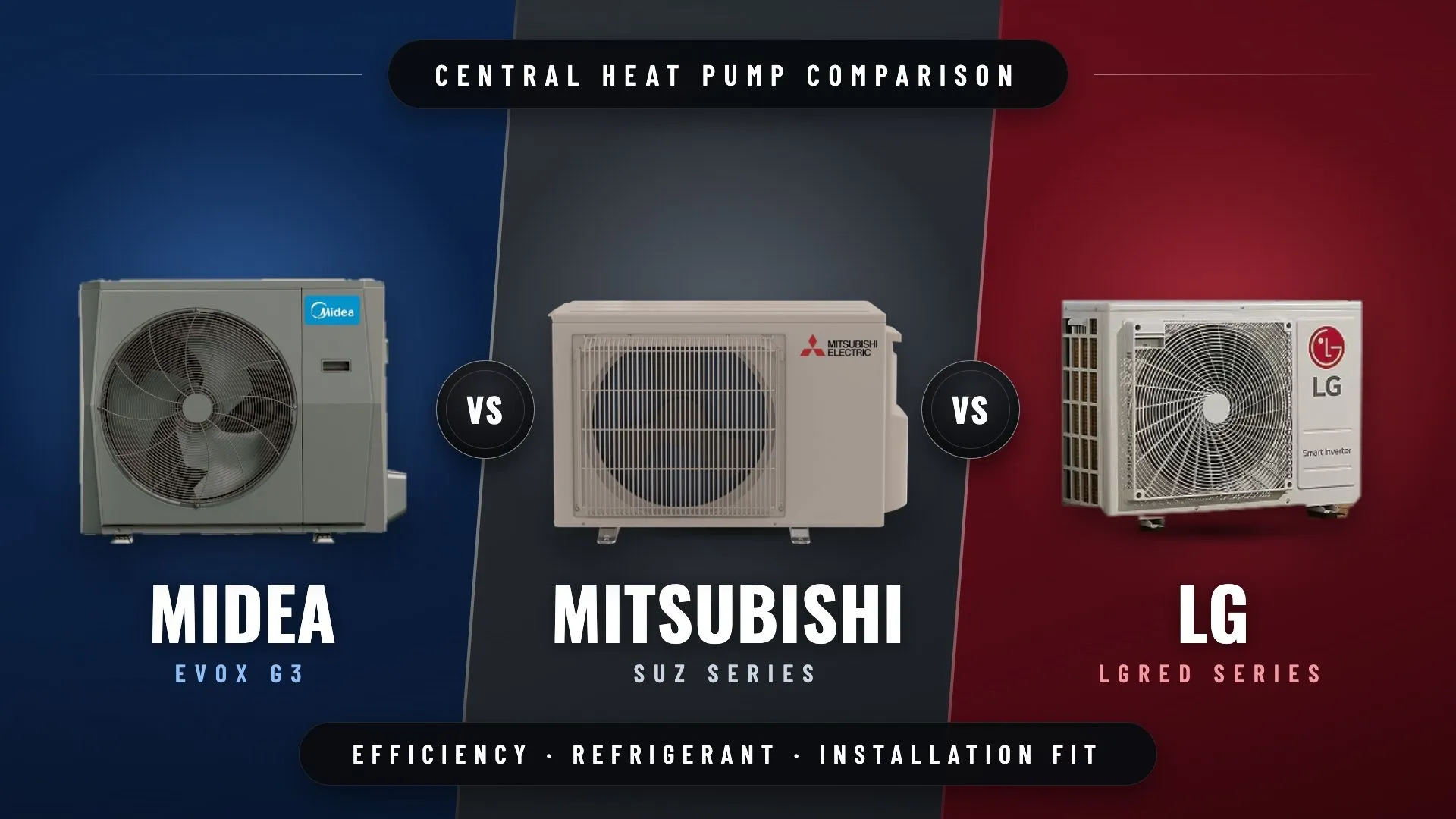
Ask three contractors which heat pump to put in your house and you will likely hear three different brand names delivered with equal confidence. The shortlist that keeps surfacing for Massachusetts homeowners replacing a furnace is Midea, Mitsubishi, and LG. All three build real cold-climate equipment, and all three have current models that qualify for Mass Save rebates, though the specific model on your quote decides that rather than the brand name. Choosing among the best central heat pumps for a Massachusetts home comes down to a handful of specifications that most brochures bury, so here is a plain comparison of where each one stands.
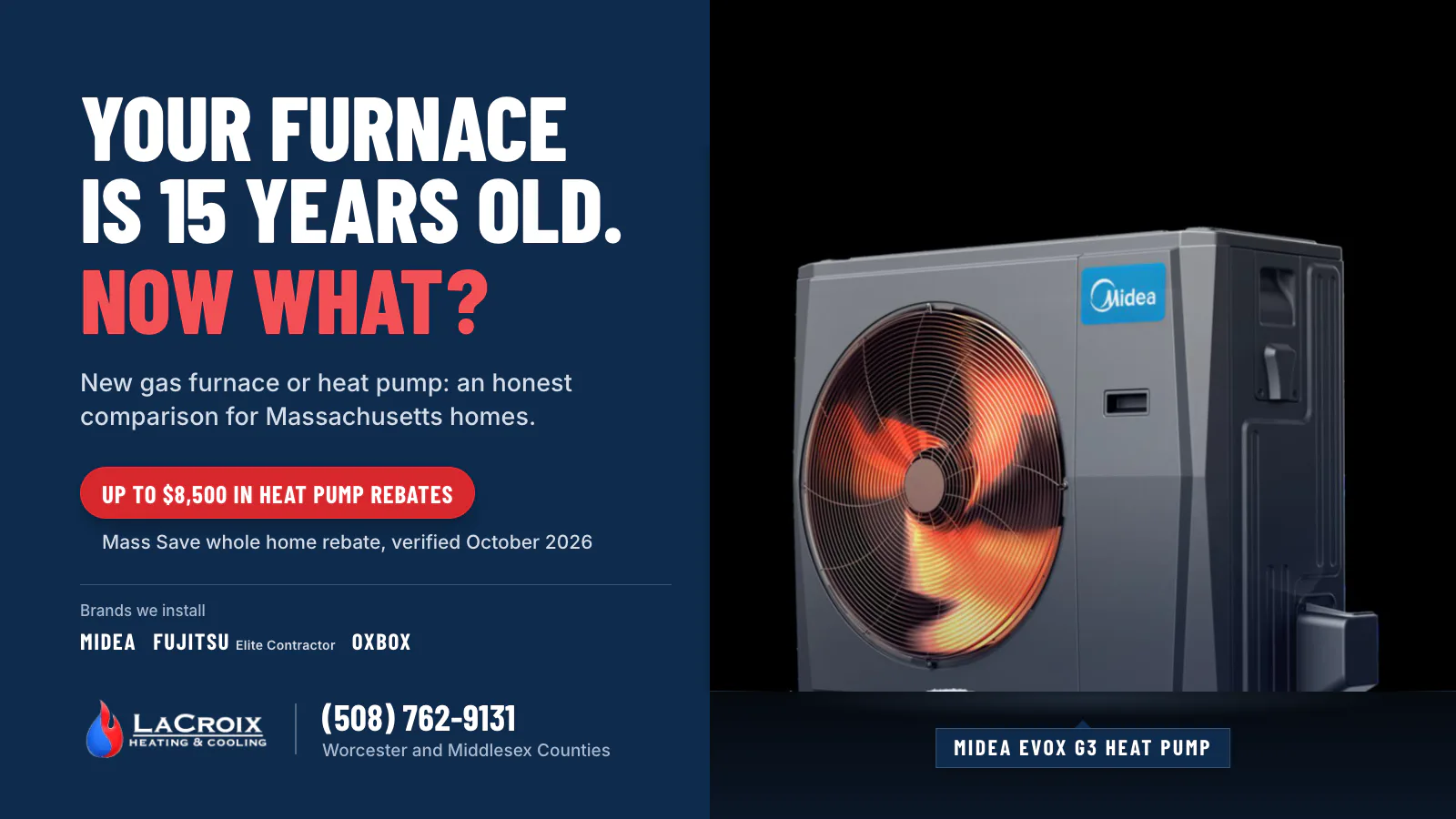
Midea EVOX G3
The EVOX G3 is a central ducted heat pump designed around retrofit projects, which describes most Massachusetts installations.
- Cold-weather output: 100 percent of rated heating output at minus 13 degrees Fahrenheit, with a COP of up to 1.9 at that temperature and 2.14 at 5 degrees.
- Efficiency: up to 19.0 SEER2 cooling, 12.5 EER2, and up to 10.8 HSPF2 heating
- Refrigerant: R-454B
- Capacity: 1.5 to 5 tons, with multi-voltage capability
- Standout feature: engineered as a direct drop-in gas furnace replacement, matching a typical furnace cabinet width, with a modular latching design that lets installers carry it into tight basements in sections
The EVOX G3 also exceeds ENERGY STAR Most Efficient and CEE Advanced Tier thresholds. Its practical appeal for a Massachusetts home is that it was built to go where a furnace currently sits without a mechanical room rebuild.
Mitsubishi Hyper-Heating
Mitsubishi has the longest cold-climate track record in New England, and that history is worth something real.
- Cold-weather output: ducted Hyper-Heating systems hold 100 percent of rated heating capacity down to 5 degrees Fahrenheit and continue operating down to minus 13 degrees
- Efficiency, ducted models: cooling ratings span a wide band from roughly 15 to 22 SEER2, with heating ratings roughly 8.2 to 9.4 HSPF2, varying by tonnage and pairing
- Refrigerant: current ducted Hyper-Heating systems use R-454B
- Standout feature: the longest cold-climate field record in New England and the densest dealer network in Massachusetts, with long compressor coverage that varies by model and generally requires registration
One important clarification. Mitsubishi's most impressive published numbers, around 12.5 HSPF2 and 20 SEER2, belong to its ductless mini-split line rather than its ducted systems. Those mini-splits are excellent, and if your home lacks ductwork they may be the better answer entirely. But they are not the comparison to make against a central ducted system.
LG LGRED
LG's cold-climate platform has become a common third option on Massachusetts quotes.
- Cold-weather output: LGRED technology is designed to hold heating capacity in low temperatures, with cold-climate systems rated to operate down to minus 13 degrees Fahrenheit
- Efficiency, ducted models: cooling ratings generally in the 17 to 19 SEER2 range depending on capacity
- Refrigerant: current ducted LGRED systems use R-32
- Standout feature: multi-positional air handlers, which give installers flexibility in awkward basements, attics, and closets common in older Massachusetts housing
As with Mitsubishi, LG's headline efficiency figures often come from ductless equipment. Insist on ducted ratings if you are replacing a furnace.
What Actually Separates Them
Strip away the branding and three things decide this.
Ducted versus ductless - If your home has usable ductwork, you are comparing central systems and only ducted ratings apply. If it does not, the entire conversation shifts toward mini-splits, where Mitsubishi's lineup is formidable. This single fact matters more than brand preference.
Retrofit fit - A furnace replacement in a cramped New England basement is a physical problem before it is an efficiency problem. The EVOX G3's furnace-width cabinet and modular design address that directly. LG's multi-positional handlers help too. Ask any contractor to walk your basement before quoting.
The refrigerant on the quote - This one is worth real money and it catches people off guard. As of January 1, 2026, any heat pump using R-410A refrigerant was removed from the Mass Save Heat Pump Qualified Products List, so it earns no rebate no matter how efficient it is or how good the price looks. Rebate-eligible systems need a next-generation refrigerant like R-32 or R-454B, ENERGY STAR Cold Climate certification, a listing on the Qualified Products List, and an installer in the Heat Pump Installer Network. Older inventory is still circulating at tempting discounts, and that discount is almost always smaller than the rebate it costs you. Verified as of August 2026.
The region behind the rating - Published HSPF2 figures usually reflect Region IV, the standard climate region for most of the country. Massachusetts is in Region V, where the same equipment rates lower. Midea publishes both for the EVOX G3, at 10.8 for Region IV and 8.8 for Region V. Every brand is tested the same way, so this does not favor anyone, but it does mean the brochure number overstates what your winter will look like. Ask for the Region V rating on every quote.
Sizing - An oversized system of any brand short cycles, dehumidifies poorly in August, and wears out sooner. A Manual J load calculation on your actual house will do more for your comfort and your bills than the difference between these three logos. If a contractor sizes from square footage alone, that is a bigger red flag than any brand on the quote.
The Honest Bottom Line
There is no single best heat pump for every Massachusetts home. For a ducted furnace replacement, the EVOX G3's retrofit engineering and strong cooling efficiency make it a compelling default. For a home without ducts or one that needs zone-by-zone control, Mitsubishi's ductless expertise is hard to beat. For unusual mechanical spaces, LG's positioning flexibility earns its place.
What all three share is that they only pay off when sized correctly, installed well, and confirmed against the Qualified Products List before the contract is signed.
It is also worth being realistic about how much the brand decision actually moves your outcome. The efficiency ranges above overlap substantially, and every system here is rated for temperatures colder than a normal Massachusetts winter delivers. Two identical homes with the same equipment can end up with very different energy bills depending on whether the ductwork was sealed, whether the load calculation was honest, and whether the installer commissioned the system properly at startup. Those variables sit entirely with your contractor, not with the logo on the cabinet.
That is why the most useful question to ask is not which brand is best. It is how many of these systems the contractor has installed in homes like yours, and whether they will show you the load calculation before you sign. A well-executed installation of any of these three will outperform a rushed installation of the theoretically superior one.
Frequently Asked Questions
What is the best heat pump brand for a Massachusetts home?
There is no universal answer, because the right choice depends on whether your home has ductwork, how your mechanical space is laid out, and your heating load. Midea, Mitsubishi, and LG all build cold-climate systems rated to minus 13 degrees Fahrenheit that can qualify for Mass Save rebates. Installation quality and correct sizing affect your results more than brand choice.
Do all three brands qualify for Mass Save rebates in 2026?
All three offer current models meeting the 2026 refrigerant requirement, with Midea and Mitsubishi ducted systems using R-454B and LG's ducted LGRED line using R-32. Eligibility is model-specific, so the exact unit must appear on the Mass Save Heat Pump Qualified Products List and be installed by a Heat Pump Installer Network contractor.
Why do ducted heat pumps have lower efficiency ratings than mini-splits?
Ducted systems push air through real sheet metal against real static pressure, and the testing standard reflects that. The same quality of machine posts a lower number in ducted form than in ductless form. This is why comparing a central heat pump against mini-split ratings produces misleading conclusions.
How cold can these heat pumps operate in a New England winter?
All three platforms discussed here are rated to operate at minus 13 degrees Fahrenheit, which is colder than a typical Massachusetts winter night. More useful than the minimum rating is how much capacity a system retains between 5 and 25 degrees, since that band covers most of the hours a New England heat pump actually works. Ask for that data on the specific model quoted.
Ready to find out which system genuinely fits your home rather than which one a salesperson prefers? LaCroix Heating and Cooling has served Massachusetts homeowners since 2012, and we size every system with a proper load calculation and confirm every model against the Qualified Products List before you commit. We are a Mass Save approved heat pump installer, and our installations carry a 1-year installation warranty plus 12-year manufacturer parts coverage. Call or text (508) 762-9131 to get started.