Call around about a new heat pump and you'll hear "it depends" a lot. That's true, but it doesn't help much when you're trying to work out if this is a $10,000 job or a $25,000 one. So here's the heat pump cost in Massachusetts at LaCroix: what each system costs after Mass Save, and what it takes to get the full rebate.
These are our current packages. Your house may need something different, and your written quote is the number that counts.
Ductless Mini Split Prices by Zone
A zone is one room or area with its own indoor unit and its own temperature control. The bold price on each line is your cost once the full 2026 whole-home Mass Save rebate comes through, if you qualify. That rebate has conditions we cover below, and it's paid after the install. The second price also takes off our November discount. Electrical work is extra.
2 zones (Fujitsu, 18,000 BTU): $10,025 after the full rebate, or $8,025 with the rebate and our November discount. Price before rebate $14,000, rebate up to $3,975.
3 zones (Fujitsu, 24,000 BTU): $13,650.50 after the full rebate, or $11,650.50 with the rebate and our November discount. Price before rebate $18,500, rebate up to $4,849.50.
4 zones (Fujitsu, 36,000 BTU): $16,235.50 after the full rebate, or $14,235.50 with the rebate and our November discount. Price before rebate $24,000, rebate up to $7,764.50.
5 zones (Midea, 48,000 BTU): $18,500 after the full rebate, or $16,500 with the rebate and our November discount. Price before rebate $27,000, rebate up to $8,500.
6 zones (Midea, 48,000 BTU): $22,500 after the full rebate, or $20,500 with the rebate and our November discount. Price before rebate $31,000, rebate up to $8,500.
Each zone you add costs about $2,300 to $4,000 more after the full rebate. So before you ask for a quote, walk the house and count the rooms you want heated. Just remember the whole-home rebate expects the system to heat all your living space, closed-up guest room included.
Central Heat Pump Prices
If your home already has ductwork, a central heat pump can use it. Ours is the Midea EVOX G3:
36,000 BTU: $14,442.50 after the full rebate, or $12,442.50 with the rebate and our November discount. Price before rebate $21,995, rebate up to $7,552.50.
60,000 BTU: $15,495 after the full rebate, or $13,495 with the rebate and our November discount. Price before rebate $23,995, rebate up to $8,500.
Look at that 36,000 BTU central system next to the 4-zone ductless at the same size. After the full rebate, the central system is about $1,800 less, and about $2,000 less before any rebate. If your ducts are in good shape, that can make central the cheaper system to buy. If you don't have ducts, adding them costs a lot more, and ductless is often the simpler job.
Our November Discount
Sign your contract by November 30, 2026, and we'll take another $2,000 off each of these systems. That's the second price on each line above. The install can come later, but it still has to be done by December 31 for the 2026 rebate. Not everyone will qualify for the rebate or the discount, and the offer can change or be canceled.
What's Not in Those Prices
Electrical work isn't included. A heat pump needs its own 240-volt circuit, and what that takes depends on your panel and how far the outdoor unit sits from it. Have us look at your panel before you sign, so the electrical cost is in your budget from the start.
Your final price can also differ from these packages. The right size for your house comes from a load calculation, and it may not match one of the packages above. Your layout matters too, since a long run between the indoor and outdoor units is more work than a short one. And if your ducts need repairs, that's part of the cost of going central.
What Mass Save Can Take Off
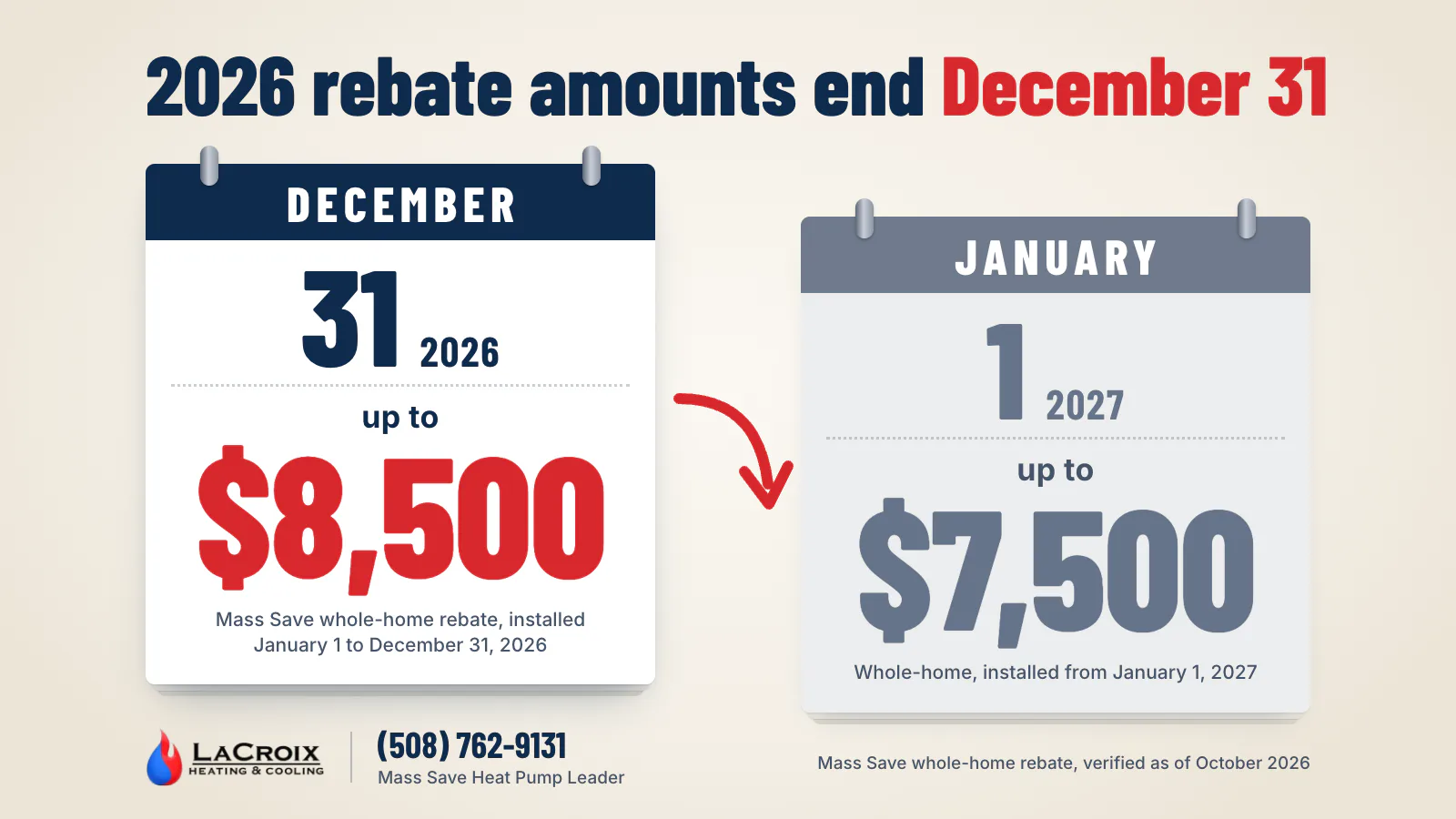
For a heat pump installed by December 31, 2026, the whole-home rebate is up to $2,650 per ton, capped at $8,500. Tons come from the system's rated cooling capacity divided by 12,000 BTUs, which is why some of the rebates above aren't round numbers. The rated capacity often comes in a little under the size we list.
To get the whole-home rate, heat pumps have to be your only source of heating and cooling. Your old system gets removed or disconnected, or it stays only to make hot water. The new system has to be sized for 90 to 120 percent of your home's heating load, and the house has to pass a weatherization check.
You pass if your house was built in 2000 or later, or if a Home Energy Assessment recommended less than $1,000 of weatherization. You also pass if you've finished the work recommended by an assessment done in 2013 or later. Both the whole-home and partial-home rebates are only for homes lived in full time all winter, and replacing an existing heat pump doesn't count.
A 2-zone or 3-zone system still has to carry the entire house to get the whole-home rate. So those prices only work for a home with a small enough heating load.
If you keep your oil, gas or propane system as a backup, you're looking at the partial-home rate instead: up to $1,125 per ton, capped at $8,500. A whole-home install that misses the weatherization test can fall back to this rate too. On our 2-zone system, that's up to $1,687.50 before any bonus, instead of $3,975, which puts it at $12,312.50 instead of $10,025.
On the partial-home rate, Mass Save adds a $500 bonus if the system is sized to heat the whole house. There's another $500 if you have a Home Energy Assessment and finish the recommended weatherization within a year before or six months after the install. Any zone where the old fuel stays in use needs an approved integrated control, and our guide to converting from oil explains how that setup works.
Income-qualified homes replacing oil, propane or electric resistance heat can get up to $16,000, or possibly pay nothing. Homes replacing natural gas aren't eligible for that one.
Some towns in our area, including Shrewsbury and Holden, run their own electric company. There, the whole-home and partial-home rebates are only available if you're replacing natural gas heat from a gas company that's part of Mass Save. Otherwise, ask your town's electric company whether it has its own heat pump rebates.
The Mass Save rebate gets claimed after the install, and online requests usually take 6 to 8 weeks. You're allowed to assign it to your installer instead of waiting for a check, so ask us how yours will work before you plan your payments.
Why the Install Date Matters
The rebate is already set to drop for 2027. For anything installed on or after January 1, the whole-home rebate is up to $2,350 per ton, capped at $7,500. On our 5-zone system, that's up to $7,500 instead of $8,500, so it would cost $19,500 after the rebate instead of $18,500. On the 2-zone, it's up to $3,525 instead of $3,975, or $10,475 instead of $10,025.
Signing a contract in December doesn't lock in the 2026 amount. The system has to be installed by December 31, and we've written a full guide to the Mass Save rebate deadline if you're cutting it close.
Other Ways to Bring the Cost Down
Massachusetts doesn't charge sales tax on heat pump system equipment for your primary home. If you'd rather spread out the cost, the Mass Save HEAT Loan offers 0 percent financing up to $25,000 on qualifying work. You have to set it up before the install. The loan can't include the amount your rebate covers, and using it for a whole-home job takes a Home Energy Assessment first. The New England Heat Pump Accelerator can also take up to $650 off a qualifying outdoor unit. We'll check whether it applies to your equipment when we quote the job.
The federal tax credit only covered improvements made through December 31, 2025, so don't count on it for a new install. Once you're up and running, you may also qualify for the seasonal heat pump electric rate, which lowers your delivery rate from November through April.
What to Budget
So what's the heat pump cost in Massachusetts for your house? With the full 2026 whole-home rebate, plan on $10,025 to $22,500 for ductless and about $14,400 to $15,500 for a central system, plus electrical work. Sign by November 30 and our discount takes another $2,000 off. Before any rebate, our prices are $14,000 to $31,000 for ductless and about $22,000 to $24,000 for central. Your own number depends on how many zones you need and which rebate you can actually get.
Frequently Asked Questions
How much does a heat pump cost in Massachusetts?
If you qualify for the full 2026 Mass Save whole-home rebate, our ductless systems run $10,025 to $22,500, from 2 zones to 6. Our central Midea EVOX G3 systems run $14,442.50 to $15,495. Before rebates, it's $14,000 to $31,000 for ductless and $21,995 to $23,995 for central. Electrical work is extra.
How much does Mass Save take off a heat pump?
For 2026 installs, the whole-home rebate is up to $2,650 per ton, capped at $8,500. If you keep your old system as a backup, the partial-home rebate is up to $1,125 per ton, also capped at $8,500. Both drop for installs on or after January 1, 2027.
Is ductless cheaper than a central heat pump?
That comes down to how many zones you need. Our 2-zone and 3-zone ductless systems cost less than our central systems. At 36,000 BTU, our central system costs about $1,800 less than a 4-zone ductless after the full rebate, as long as your existing ducts are in good shape.
Is electrical work included in the price?
No. Heat pumps need a dedicated 240-volt circuit, and electrical work is a separate cost, so ask us to look at your panel.
Talk to Us About Your Heat Pump
If you want the real heat pump cost for your house, give us a call. LaCroix Heating and Cooling installs heat pumps for homeowners across Worcester and Middlesex Counties, and our office staff can walk you through the Mass Save rebate. We're a Fujitsu Elite Contractor and a Mass Save Heat Pump Leader. Our installs come with a 1-year installation warranty on top of the manufacturer's coverage. Our number is (508) 762-9131, or you can contact us online.